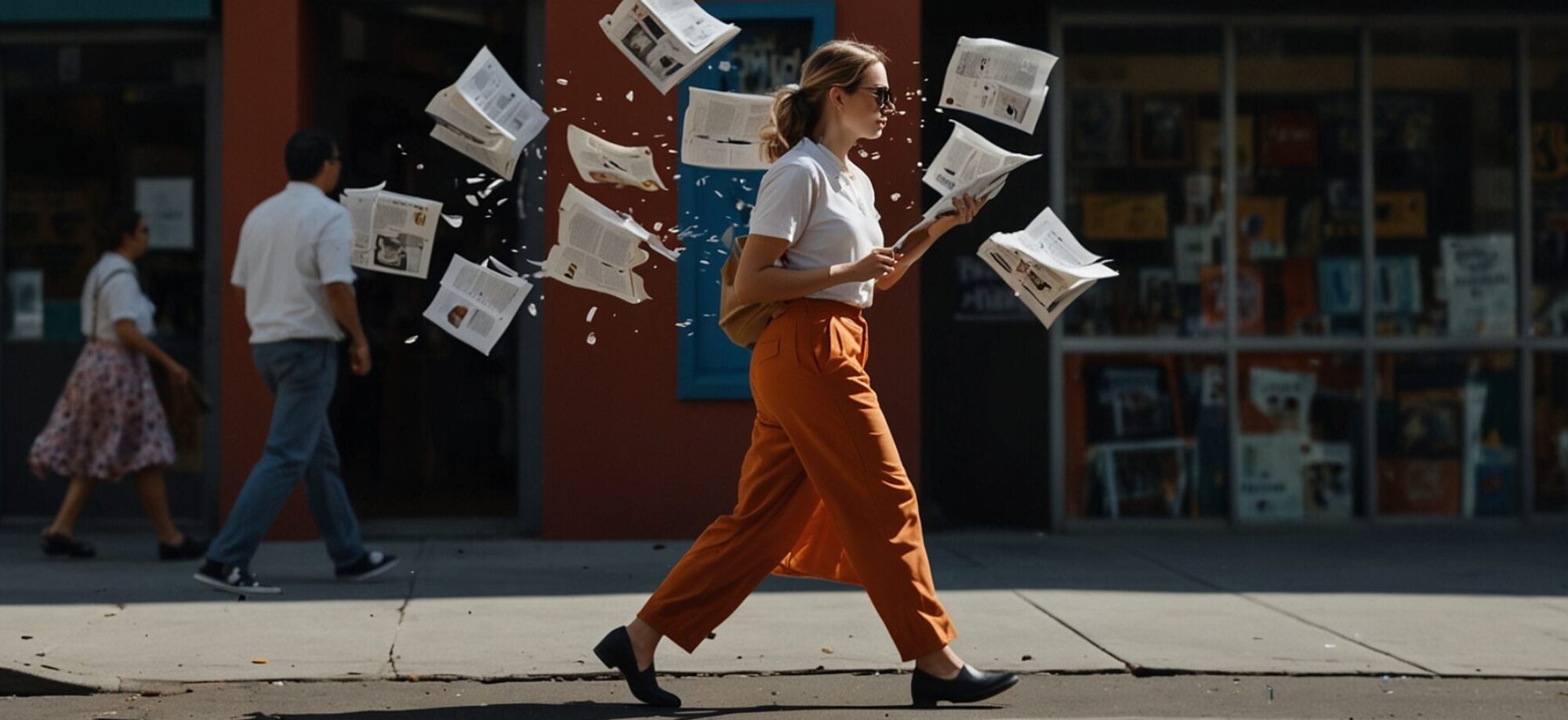
LISTENING TO OUR BODY WHILE WALKING

First of all, I would like to apologize because the topic was very extensive in its exposition, however, I decided to present it in a single issue due to its importance and not to divide it into several parts, so that the readers themselves are the ones who decide the rhythm in its reading, analysis and implementation of the different aspects that I consider should be taken into account.

1.            Body language.

The purpose of the present publication is to demonstrate that our body -when walking in a natural way- does it with its own language, very expressive, plain and revealing, by means of which it communicates to us -with a certain freedom- what it is feeling and perceiving.

Traducido al Español

Let us keep in mind that the physical body manifests itself in the “company” of the mind, habits, conditioning and its own physical abilities and restrictions, to respond to the different demands that we make of it on a daily basis.

This makes us aware that we will have to observe and “listen” to it in order to know its capacities, incapacities, abilities and disabilities, as well as to have a better and greater knowledge of ourselves.

By means of this body language we can distinguish several ways of communication according to the form and the part of the body that is used. Thus we can distinguish the gesticulation of certain body members according to their particular movements, the general position observed by the body, the mimicry practiced, the gestures and grimaces generated by the face, and other diverse modes of positioning and physical expression that we will analyze throughout this topic.

2. For what causes and reasons does our body communicate?

Apart from its direct and expressive physical language, our body has a symbolic body language, which we must know and understand, being always ready to “listen” to what it is communicating to us.

Its physical expressions are intended to convey what is brewing inside us, mainly how we feel.

One of them is to listen to it in order to know its faculties (capacities, aptitudes, virtues, skills, abilities), its functioning (uses, performances), its organic and physiological functions, and its natural and essential movements (stability and instability, balance, speeds, displacements, dynamism, rhythms, compasses, styles), including knowing about its incapacities and clumsiness. Another purpose is to dialogue with him, to know his needs and to be able to give him what he asks for.

3.            Body language in a healthy state.

There are few times that we want to listen voluntarily and consciously to our body; however, in general terms, we get to know it unconsciously, as time goes by and years go by; in this way we learn to know it, but without becoming aware of it. To do it in a conscious way is enriching, because its unveiling results in greater clarity and quality: by doing it in a more conscious way we learn better to understand its expressions, postures and placements. In a word, we learn from it, even without intending to, of its healthy state.

4.            Body language in a morbid state.

Body expressions also allow us to know our own mood, emotional and physical state when we are sick. Thus, our body is an excellent translator of the diseases, ailments, discomforts that we suffer, both physical and emotional and psychological. If we pay attention to its poses and expressions we will be able to know our deepest afflictions, our discomforts and discouragements -physical and mental-, the morbid symptoms by means of its postures, forms, demeanors and gestures; and paying attention to the different corporal members, as far as the aspect, coloration, pigmentation, tonality and texture of the skin, in all its different organic and physical sections. In general, we will be able to know and understand, through its particular language, its physical and mental manifestations.

Negative and harmful emotions (noxious, harmful, bad, evil, malignant, pernicious, destructive), translated through body language, is a valuable mechanism for their knowledge and understanding, which will help us to their transformation and correction (Post THE POWER OF EMOTIONS; Future Post AUTOLIBERATION OF NEGATIVE EMOTIONS THROUGH SELF-SUGGESTIBILITY METHOD).

We must be attentive to listen to his laments, his complaints, his indispositions, his ailments and his sufferings in order to support it in its full development, a situation that will help us ourselves.

5.            Expressive forms of the body

The body manifests and communicates when it is at relax (rest) or in movement (work). In these 2 stages we can observe it with its special language, through which it will be constantly communicating its state of health, energy and resistance (Post THE WALK-RWD SYSTEM IS AN EFFECTIVE METHOD OF RESILIENCE). Its expressions are different in both stages, so we must learn to know it in these 2 situations.

As for the resting stage, we will have to be attentive to its expressions -organic, physiological and physical- when it is standing, lying down or sitting. In these postures his indexes and other organic and vital signs behave differently.

It is in the skin that we can most objectively notice (to see) their expression. The body is covered entirely by the skin, which communicates itself by its coloration, appearance, pigmentation, spots, freckles, moles, macules, etc., as well as by its texture and shades.

6.            Most expressive parts of the body

When the body is in the rest-standing position (erect), its expression can be very widely variable, because it can be vertical, bent, twisted, etc., the legs elongated, retracted, open, closed, together, separated, etc., the arms elongated, retracted, resting, etc., the hands closed, open, etc., the shoulders retracted, shrugged, etc., the head haughty, lowered, drooping, etc., the eyes fixed, distracted, surly, astonished, sad, etc., the brow furrowed, relaxed, dilated, etc., the muscles of the face tense, elastic, dilated, etc. All these combinations project an enormous amount of possibilities with respect to bodily expressions.

If the body is at rest-lying down we get another series of similar combinations, as well as if it is seated. These combinations increase if the body is in motion.

As we can see, body language is quite expressive in terms of the multitude of positions and capacities it has to communicate, whether to alert, protest, reflect, insinuate, specify or emphasize some ailment, suffering, pleasure, illness, pain, discomfort, contentment, liking, sadness, joy, even boredom, disgust and annoyance.

Moreover, as we have already mentioned, the postures and physical expressions of the body are quite different when the individual is healthy and when he is sick. To know and understand it, it must be observed from head to toe.

Likewise, we can point out that in the practice of walking, this activity (exercise) is performed differently if you are sick or if you are healthy: walking can be done with a firm or weak bearing, more upright or hunched, with straight shoulders, weak, stiff or relaxed. The eyes can convey liveliness, sharpness, brightness and dynamism, or the opposite, apathy, disinterest, sadness, faintness.

Now, from the point of view of the importance of walking in this dialogue with the body, we must point out that the mere walking transmutes all the negative issues, redirecting and distributing them throughout the body; so if we walk we will have to provoke an impulse to our body to transfer large amounts of negative charges to absorb them in other body parts that can be damped or dissolved; although also, depending on the morbid state that the individual has at the moment of the walk, it can be excitable and not advisable to walk; for example if we have an ankle injury, the recommendation is not to walk, until the ankle has improved.

Let’s go to another example. The face is one of the parts where we can find the best expression of our body when we walk. When we have just walked for 5 or 10 minutes we will observe that immediately a relaxation is exerted in all the muscles of the face (Future Post WALKING AND THE 660 MUSCLES OF OUR BODY): non-relaxation and wrinkles are always correlated. But if we initiate a walk, in a natural way, we will be inviting relaxation and wrinkle relaxation to walk on the same path with us. This example of how we relax our facial muscles serves to understand how it would work for the rest of our bodily tensions and conditions, as we start walking. The body will immediately begin to send us messages of its acceptance and approval.

Other examples are those related to the muscular system, the circulatory, cardiovascular, respiratory, where in general it is advisable to walk (under a special program that your medical specialist will prescribe); and a very particular case is that of Dyskinesia, the alteration of the movement of some or some voluntary muscles; disturbance (alteration, indisposition, disorder, disarrangement) that is generated when there is an abnormality in an area of the body with respect to the muscles on which we have voluntary disposition to make them work.

Another one is cramps. Regardless of the cause of these cramps, the recommendation is to stand up straight and start walking; little by little -while walking- the cramp will gradually subside and dissipate.

7.            The symbolism of body language.

Undoubtedly, an important part of body language is symbolic, that is, each expression means a message that we must know, translate and understand (Post WALKING AND ITS SYMBOLISM).

We could affirm, in this sense, that the human body transmits:

– Universal symbolic language

– Knowledge of ourselves

– Better perception and understanding of the people close to us, by observing the messages of their respective bodies.

In general, we can say that body language is universal, however, each person has some features that differentiate them in a particular way, which must be known and interpreted. To complement our understanding of our body we must resort to the symbol, which as a mental construction (unconscious and spiritual) there are differences in each of our bodies but not substantial. From each unit, member, organ or body gland we can make a symbolic abstraction. While one of them communicates, the others remain quiet, suspended, lagging behind, but not inert (mute).

This symbolic language through which the human body communicates is a reliable interpreter of our interiority, of our feelings, emotions, thoughts and how we feel at certain moments; so it is essential to be always ready to listen to it and try permanently to discern what it is communicating to us.

To consciously pay attention to our body will allow us to understand its expressions and to have a better knowledge of ourselves, of how we are in general and in the different conditions where we are interacting with other people and even in moments of solitude. The different forms and postures that our body is used to perform are a direct response and translation of who we are, how we feel, think and why we behave before other people and in front of the physical and social environment that has surrounded us.

Voluntarily, we can achieve a dialogue with our body for as long as we wish.

There is no doubt that a practical, reliable and effective way to express what we feel and think is through our body, through its “cryptosomatic” language. Observing its movements and postures is a positive way of how we can get to know ourselves better, since bodily expression is a direct and evident translation and interpretation of how we are. The body has its own symbolic language, the cryptosomatic.

Each form and its respective physical variations that are expressed by the different parts of the body, are manifestations that contain symbolic information of our interiority, which we have captured and experienced over time.

We could say that the body is a reliable translator of:

(a) How and how much we appreciate, judge and believe in ourselves.

b) How and in what way we perceive ourselves, understand ourselves and regret our inner feelings.

c) How much we grieve, suffer, get sad or depressed by the bad experiences we have.

d) How much we rejoice, have fun and get excited about the good things that happen to us.

e) How much we sympathize and feel sorry (moved) for what happens to other people close to us.

f) How much we are annoyed, upset or disconsolate by a concrete situation that we have lived or are suffering.

g) How we feel emotionally.

8.            The body as an expression of interiority.

Sometimes we do not know how we feel in certain circumstances. We cannot perceive our emotions correctly. The mind is unable -sometimes- to distinguish if we suffer from anguish, impatience, anxiety, stress, sadness, indecision, uncertainty, to name only some of the emotions that constantly overwhelm us.

Body expressions can help us to know what type of emotion we are suffering from. The behavior or body expression is different depending on the affliction we are suffering. We only have to observe its physical manifestations to help us know what we are suffering in our interiority: headache, reddening of the face, hardened or hunched position, and dozens of other bodily revelations.

9.            The muscular, bony and epidermal systems as fundamental parts of body language.

In the first instance, I believe it is necessary to recommend that a classification and grouping of the muscles of the body should be made in order to facilitate their participation in body language (Future Post WALKING AND THE 660 MUSCLES OF OUR BODY). The same should be done with respect to the bones that make up the human body (Future Post WALKING AND THE 206 BONES OF OUR BODY). These actions will allow a better understanding of the body language and the application of the WALK-RWD system in the different muscle and bone categories, to improve our dialogue with the body.

The skin covers the totality of the human body, and it is through it that we can become aware of certain things that we want to communicate and sometimes we cannot do it using other parts of it; therefore we should always be attentive to its coloring, tonality, temperature, sweating, dryness, etc. (Future Post THE SKIN AND THE WALK-RWD SYSTEM).

The simple natural walking is a dialogue that is established with our body. What we transmit and communicate directly through walking is a precise perspective (directive, orientation, prescriptive) for the reanimation of the limbs, muscles, bones and joints, a message that is received by the majority of all of them that make up the human body. An unconscious and involuntary conversation in which a manifest interest is linked to all the components of the body, in addition to the organs, systems and glands.

10.          Voluntary formulation of signs with certain parts of the body.

The signs that we have created voluntarily through the millennia, with some parts of the human body, are numerous and practically recognized worldwide.

It would be irrelevant for anyone to devote efforts to draw only those of social and technical type that are emitted with the fingers and hands. There are also emotional and psychological signs that are created with other parts of the body; there are signs for all kinds of manifestations: genuflection or bowing, submission, greeting, kneeling, prostrating, denial with the head, nodding or affirming with the head, respect, signs with the hands and fingers, kneeling, venerating, authorization, asking for a ride, ok or approval, handshake, acceptance and hand treatment, denial with the hand and fingers, acceptance with the finger, and hundreds more.

11.          The WALK-RWD system stimulates the body to communicate (encourages body expression).

THE VOICE OF THE BODY

Sometimes we “hear” our body protesting about its bad physical and mental (emotional and psychic) situation.

In what ways does our body communicate? In what ways does it protest? There are several ways it uses to do so. Let’s look at some of them.

It is very clear that when we get sick it is communicating this to us; when a leg hurts, an eye, any organ. To know these signals I recommend you to read Louise L. Hay’s book, entitled “You can heal your life”. It is a real “thematic dictionary” of experiences where we can find the correlation of organs, systems, glands, etc., with the type of “lack of attention”, to call it in this generic way, towards these functional parts of the human body. In its 200 pages, all the relationships we wish to know between “diseased organ” and the cause of its disease are pointed out.

The human body – mental and physical – also resorts to dreams to communicate its problems to us.

Writing is also a means that can help us to better understand our body, because it not only reveals to us the deep psychological issues, those that are intimately related to the instincts, to the unconscious, whether individual or collective, about emotions, and any psychic ailment that when projected onto the things and characters we write about, throws us encrypted information about it (Posts WRITING TO ACCEPT BETTER OURSELVE, WHILE WALKING; WHY AND WHAT TO WRITE FOR?; HABITUAL PURPOSES AND MOTIVES IN WRITING), but also in a less hermetic way, on our body.

Drawing is another symbolic means that supports us in this corporal unveiling (Posts READING-WRITING-DRAWING: VIRTUOUS CIRCLE; DRAWING AS SYMBOLIC LANGUAGE).

Now, let’s go to our specific case: How can we listen to our body when we walk?

There are several scenarios to receive this information.

Certain psychological theories explain that some pains or stiffness in certain parts of the body, reveal problems of prejudiced, neurotic, obsessive, paranoid, maniacal, ideational, compulsive, etc., that according to that pain or stiffness in a certain limb, muscle, sense or bone, is how our body reflects or communicates some of the aforementioned discomfort.

In these cases the physical body is not necessarily the one that is suffering from some problem, but it reflects a certain psychological or emotional discomfort.

Louise L. Hay guides us both in cases where the body is the physical sufferer and in related psychological cases.

Of course, what we intend here is to learn to listen to our body when we walk (WALKING AND ITS SYMBOLISM).

Let’s move on to that process.

FIRST ACT. The desire, or not, to go for a walk. This first event occurs when we can observe our physical body in that initial communication confrontation of pleasure-satisfaction-joy or disturbance-disorder-unwillingness. Do we wish to walk or not? Our body must have the decision and nothing else. Let our physical body speak and not the mental part. If we manage to differentiate what the physical part feels from the mental part, we will be able to advance in truly knowing what we wish to do; let us keep in mind that our true inner self -our personality- must be the one who decides according to what we truly wish to be and act (Future Post THE PERSONALITY DEFINED BY THE PACE WHEN WALKING). Let us leave behind those social, work, etc., conditioning factors, as far as possible, that limit our essential unconscious desires.

The body language will be defined between the two vectors of pleasure-satisfaction-joy and disturbance-disorder- unwillingness.

SECOND ACT: Is our body tired or not? The tiredness that our physical body transmits to us will be the one who makes the decision to start our walk.

Again, let’s ignore the mental part. Let us observe and feel our physical body. It does have the desire to walk, it is the mental part that does not.

The signals in these two senses start even before we start walking. If we feel tired, it may be a sign of our emotional state. Let’s check this.

Is it a sign of our physical body? It is telling us that our body does not want to walk and is communicating this to us. However, let’s not get confused, it could be our mind that is preventing us from enjoying a walk.

Let’s do a simulation. Let’s go for a walk. If after 5 minutes – only 5 minutes! – of walking we feel a tiredness that prevents us from continuing the walk, then perhaps our body is indeed tired, sick or in pain. Let us think that it is indeed trying to tell us that or some other message.

If we continue walking, despite the fact that it keeps telling us that it is sore or tired, it may slip, trip, fall, sprain or even break, so we should stop walking.

Should we really stop walking?

This is a vicious circle. If we continue, we may find ourselves lying on the ground. Walking is an exercise to improve and restore the physical body. How is it possible that the benefit of the activity of walking prevents us from doing it?

Let’s use the method of the VICIOUS CIRCLE and how to break it (Post NEGATIVE HABITS AND HOW TO COMBAT THEM. GENERAL CASES). Let’s analyze the chain and see how we can determine the obstructive link to replace it with a vital and effective relief.

We must be very cautious at this stage as the communication may be of the danger type, i.e., cases where our body starts to feel short of breath, or feel tachycardia, or any other discomfort. These are very important signals from our body, which we should take care of immediately.

Any irregularity or discomfort should be heeded. We must stop walking for good. Not one more step.

THIRD ACT. If after those 5 minutes -and up to 15 minutes- of walking you feel that your body does not want to continue walking, it may be that you are being “advised” by that part that exists in every human being not to make efforts of this type and better stay sleeping or resting at home; or your Thanatos instinct is very strong and is dominating the Eros instinct. What does all this mean?

When the Thanatos instinct dominates at a high level, it means that there are forces in the mental stage of a person, which are emotional and will have to be corrected by relying on the same force of psychological breakdown. The negative emotional energies -understood within the aforementioned circle of psychic ailments- live and regenerate from the same thing that affects the mind of the human being, therefore it is very difficult to diminish this accumulated force Thanatos (death instinct).

The recipe is simple, but difficult to put into practice by the affected person: to confront the Thanatos instinct with the Eros instinct, but not only that, and it is the most complex of the matter, to support it for this confrontation. But there is the resource of Thanatos that is reinforced by the same effect it generates. The person DOES NOT WANT to improve, and therefore will not help his Eros instinct, and he does not want to because that is precisely what Thanatos transmits (Future Post WALKING WITH EROS AND THANATOS).

It depends on the level of Thanatos, on the negative emotion so that we can confront Thanatos. In the near future we will present several posts that will describe a method that can be used for this type of messages from the body, when the Thanatos instinct has overpowered it and does not even have a real physical ailment (Posts THE POWER OF EMOTIONS, EMOTIONS AND THE WALK-RWD SYSTEM; Future Posts RELEASED EMOTION METHOD; AUTOLIBERATION OF NEGATIVE EMOTIONS THROUGH SELF-SUGGESTIONABILITY METHOD and PARADOXICAL EMOTIONAL PROGRAMMING).

12.          How to improve the understanding of body language.

The different activities, modules and structured briefs in the WALK-RWD system are elements that allow a fluid and adequate communication with the two parts that integrate the human body, the physical and the mental.

The application of the System, on the one hand, is a functional mechanism to awaken the communication with the body – stimulating and propulsive – towards its two constitutive spheres, which can hardly be resisted; and on the other hand, it is a set of actions that serve as a response to its demands of the organic and cultural type, as well as for the prevention of its health and as repairers of its different morbid states.

It is advisable to be attentive to their communications and always try to understand their direct and symbolic messages, which are usually simple in their translation but sometimes carry hermetic messages.

Given the relevance of this, later on, in a future post we will present the synthetic modules of the WALK-RWD system, in order to facilitate these actions, with the specific objective of listening better, increasing attention and communicating with our body with greater quality. This will also allow us to overcome our understanding of the corporal messages, in relation and according to each part or physical set of the body. Only by listening to it we will be able to understand it (Future Post REGROUPING FUNCTIONAL MODULES THROUGH WALK-RWD SYSTEM FOR BODY COMMUNICATION). Your understanding will be intensified and facilitated (made easier, in quality) through each added physical part or functional synthesized module.

13.          Dancing. A natural mechanism of communication of the healthy body.

Dance and any of its artistic expressions (*), is a corporal manifestation made language.

Regarding the conjunction and harmony of the body with music, there are elements that correlate them intimately, such as rhythm, pauses, silences, cadence, compass, and all of them in movement, in vibration, with displacements, in rest and balance. For those people who are inclined and practice dancing, and also for those individuals who have been told -or they believe- that they do not have rhythm, this conceptualization will be presented in the future Post THE WALK-RWD SYSTEM AND DANCE, because they may not respond to traditional rhythms, however, all human beings have their own musical rhythm, and for that reason the same WALK-RWD system orients them to how to be able to know their own compass that will allow them to accept it and to execute it, because for sure they will be able to discover new movements and rhythms, since this is similar to what happens in the plastic artistic environment, including in the musical one, that discover new styles (**Method to liberate the artist that we all carry inside) those people that accept themselves as they are, with their forms and styles that are unrepeatable.

Now, I would like to transmit some opinions that I have made in my book Tap Tap, Plastic and Poetry, 2017 (***) and that perhaps are very extensive, but I consider it necessary to transmit to you what at that time I wrote about the importance of the hands in that Tap Tap dance:

“…to point out the importance and value of the hands in this dance. Talking about their movements and positions implies including the arms of each one of them, they are an inseparable binomial, so when I refer to them I will be involving their arms.

The gesticular expression of the hands is undeniable, being almost as important as the gesticulation of the face and the eloquence of the spoken form of the human being.

The different positions and movements of them [the hands] articulate different codes and images of expression, together with the classic gestures that we use every day.

Each tap movement in this exercise can be reinforced with the hands; the dance is performed with the whole body and this complete image can be substantially modified with the relevant position of only one of the hands, and even more so if we generate an outstanding movement of it. Not to mention if it is performed with both hands in tune. The hand is a member organ of RHYTHM, as well as of touch, creating and speaking.

The hands are organic representations of the human unconscious, it harmonizes the unconscious with the conscious, transmitting to the latter the original feeling of the being, of its spirit.

The gestures and postures of the hands are physical dispositions emanated from the original substrate of the unconscious that should be adapted to each one of the movements of both arts [Tap Tap and Plastic Arts or Poetry].

With our hands we highlight our sufferings and our joys. Both the lacks and absences as well as the abundances and opulences are clearly represented by the hand.

First the organ of speech and then the instrument-limb of the hand, these are the 2 best means by which the human being can communicate and manifest his sensations and emotions.

The hands can signify extreme variants of affirmation, negation, dejection, rest, energy, enunciation, exclamation, protest, insinuation, indication, pointing, suggestion, precision, reiteration, silence, concealment, concealment, sadness, contentment, and so we could go on writing an endless list of manual modes of expression.

Likewise, as we have already mentioned, the hands can play a very important role in each step that is executed; they can give a more or less significant expression to the rhythms and the musicalization of Tap Tap.

The Tac Tac is the music of percussion with the fingers and with the palms of the hands open. Like the Tap Tap in its musical variant, the Tac Tac is a percussion music, that is to say, of percussive sounds.

Let us keep in mind what we have pointed out about the participation of the hands at the moment of performing the steps of Tap Tap, because their own language fused in posture, height and movements, are these very important instruments that can be articulated in the development of the harmonization of these 3 arts [Tap Tap, Plastic and Poetry], that we could even qualify them as physical allegories that decisively support the poetic expression; consecutive physical allegories that are conjugated in the rhythmic and cadenced expression of Tap Tap with Poetry and Plastic.

Just as the hands can emphasize what the voice – the poem – says, so it does in Tap Tap. The participation of the language of the hand in our task is double, it can agglutinate the sensitive and expressive projections of the voice with those of the dance, the poetry with the Tap Tap. However, the projection of the voice on the hand is not at all easy in terms of physical representation, neither is that of Tap Tap, more difficult is to find a harmony that combines the 3 artistic manifestations.

In any Tap Tap dance, the hands play a very important role and even more in these artistic harmonizations. Each step is transformed into an attractive impact by the movement and position of them.”

(*) Dance and any of its artistic expressions are performed with rhythmic movements. Dance is the natural movement of the human being, which responds to a personal rhythm (or a musical one) and which is performed either by means of established steps and sequences or only by means of an individual beat. Other expressions are the dance that follows a musical rhythm and established steps and sequences to be performed individually or in a group. Animals (mammals, birds, etc.) do not dance because they cannot follow a rhythm; they only dance to their own musical rhythm.

(**) Pinera, Edel C., Method to liberate the artist that we all carry inside, EMULISA, México, 1998.

(***)Loya Lopátegui, Carlos, Tap Tap, Plástica y Poesía, Emulisa, Mexico, 2017.

14.          The WALK-RWD system supporting the body to transmute the negative physical sequels (derivations and ramifications).

The negative or unpleasant emotions are, in part, a symptom of the inflexibility and severity that we have exercised in our being, and are reflected in the rigidity of some parts of our body (Future Posts THE WALK-RWD SYSTEM AND THE STRETCHING OF THE MUSCLES, and WALKING, THE STRETCHING IN LEGS AND THE YAWN). We must free the body to express to us, on the one hand, its state of energy, health, euphoria; or, on the other hand, to express to us its state of illness, disturbance or agony.

When we walk we can feel its physical state, it speaks to us in a silent and clear way and openly communicates the state it is in.

Walking allows us to encourage our body by reviving and strengthening it (Post ADDITIONAL BENEFITS IN THE CONDITIONING OF THE BODY AND THE MIND). This is achieved by reactivating the body sectors that we have not allowed them any flexibility and in that sense we have treated them with a severity of non-exercise or physical inactivity.

With the WALK-RWD system we will put in movements those parts that have been rigid, immovable, and that we have observed and felt them with a great numbness and not flexible at all, that sometimes reach the paralyzation. The application of the system, through its 4 fundamental activities, we can create various positive impulses and encouragement to the body (relaxation, abstraction, meditation, ecstasy, carefree, tranquility, etc.), promoting that support that allows it to transmute (move) most of the negative experiences.

We have already mentioned the benefits that are generated by the practice of walking, along with the other structured activities within the System, by putting in motion the neurons of the brain, the senses (physical and spiritual), the glandular production of hormones, endocrine substances and others (Posts THE WALK-RWD SYSTEM AND ITS BENEFITS IN HEALTH, THE WALK-RWD SYSTEM AND THE SELF-PRODUCTION OF ORGANIC SUBSTANCES), which allow the body to maintain or reestablish its balance, harmony and its state of health.

The human body, when put into movement, through walking, activates various systems of the organism, as well as organs and glands, in such a way that all of them are prepared to improve their functioning, eliminating those imbalances, both physical and emotional.

During the application of the WALK-RWD System, whether reading, or writing, or drawing, while walking, the body is vivified and strengthened, energy that in turn transmits (a communication to the physical and mental body) to all the organs and glandular systems of the organism, achieving an improvement of its general state. Each activity structured within the WALK-RWD System and that we put into practice simultaneously when we walk, generates a communication with different parts of the body, in such a way, that it allows a conscious and unconscious feedback, with those parts that are naturally participating in the dialogue. That is to say, that this “work” performed when applying the WALK-RWD System, drives the rational and irrational communication, that is to say, conscious and unconscious, whether the latter is called natural, instinctive, emotional, artistic or spiritual, so we will be dialoguing with the essence of the body, with the bodily self, with our intimate body that participates in these 3 structured activities, while we walk.

15.          Consciousness and the unconscious. Thoughts and feelings as nourishing elements of the human body.

In order to schematize a little this complex mechanism that feeds our body, we will mention two well differentiated categories: the source that supplies our organism from the outside and the one that flows within our interiority, such as feelings, thoughts, ideas and emotions.

We have a great ignorance of the latter when it comes to our own. Many times we do not understand ourselves: we do not know who we are, nor what we really need, let alone what or who we wish to be.

All those elements related to our mind, whether they are separated, added, combined or juxtaposed, such as affections, emotions, feelings, flow through our organism in an unconscious way until the moment when, due to certain negative events -also of the positive type-, we notice their existence and approach their knowledge and understanding. It is an unconscious and unintentional flow.

This recognition of its existence we generally do it thanks to our body, and fundamentally to its physical parts (body language, organs, systems, glands, etc.). The body is the unconscious expression of our state of health (unhealthy, healthy, strong, hurt, wounded, vigorous, aching, numb, healed, hardened, etc.), and it is also a reliable translator of our emotions and feelings.

Our body is the one who manifests what we are, who shows, reveals and expresses the true feeling of ourselves.

That inner flow – our ideas, thoughts, emotions, etc. – provoke different reactions from our body; in other words: the conscious and unconscious mind uses the body to manifest what we feel, which in turn, the body is the ideal medium to express the elements that make up that inner flow.

On unconscious issues, we have already commented on the concomitant relationships between psychoanalysis and the WALK-RWD system: catharsis and expression, purging and uttering; in this field I propose that from time to time reading -one of the structured activities of the system- be done out loud (Post WALK AND READ IN LOUD VOICE, Future Post WALK READING POETRY ALOUD); likewise, to write aloud, since writing is re-writing what is read, and of course, also aloud (Post DIALOGUE WITH OURSELVES AS WE READ AND WALK); as a mechanism that we can always use to extract from the unconscious what the consciousness has repressed (Post READING-WRITING-DRAWING: VIRTUOUS CIRCLE , Post DRAWING AS A SYMBOLIC LANGUAGE); the activity of “reading” aloud what we have written -not from other authors- manifests a freedom of our personal expression.

16.          The individual unconscious is a user of the physical body.

I would like to underline the following: The healthy, acceptable and balanced expression of our organism, both physical and mental, is generated when our conscious part is equanimous. Our unconscious is a permanent user of the body; it communicates through it – and other means – using it to send its messages – more or less encrypted – to be captured and attended to by the consciousness. Both positive and negative messages.

A fall, a blow to the head, a car crash, a fracture, a headache, and the dozens of cases mentioned by Louise L. Hay, which are unfailingly proterious but less violent messages of incidents and illnesses that the unconscious tries to warn and correct through them. The body is the ideal medium for this function of the unconscious.

17.          Teach our body new positive positions to improve our health.

We must allow our self and our unconscious to express itself freely, in any of the ways it uses to do so: orally, through writing, in dreams, through illnesses, ailments, failed acts; and we must also be attentive to these different means of communication, and in our case, we must allow it to do so through our body, by dancing, running, but above all by walking.

We must learn to listen and understand our body in its manifestations, postures, the tone and volume of our voice, its deficiencies, the smile, the frown, its capacities, the hands in our pockets, our crossed or trembling legs, etc.

But how much can the body communicate? The way it expresses itself is obviously not by speaking, but by expressing itself with movements, postures, cadences, rhythms, and other forms that from now on we will begin to observe. In order for him to be able to do it freely we must instruct him, exercise him, train him, leaving him free to do exercises, and walking and dancing are the 2 ideal ways to do it (achieve it) ideally. In the following we will refer to walking, but all that we express can be attributed in the same syntony to dancing. If there is something different, we will point it out.

The walk is to the body (corporal expression) as the voice is to the speech (oral expression). We explained and demonstrated this sentence in a Future Post WALK READING POETRY ALOUD. Habit is the excellent way to teach our body to function better, both in its physical and mental functions.

We have already talked about the habit (Post THE WALK-RWD SYSTEM AND THE HABITS); here it only remains to mention that “habituating” our body to improve its physical expressions, we can make it healthier, by modifying and reorienting the negative causes.

In the future, each one of us will have to discover the bodily expressions that signify annoying or unhealthy attitudes, in order to combat them in order to eliminate them (Post NEGATIVE HABITS AND HOW TO COMBAT THEM. GENERAL CASES). This will have an immediate effect on the direct harmful cause, but it will also send messages to the rest of the body systems, to other organs and glands of the organism.

Of course, these corrections will also have other positive effects since they will improve the body language towards other people and the social environment. A symbolic reprogramming of our own body language. A positive symbology against the usual negative one. One of the concrete results will be the achievement of greater self-confidence, since we will be more aware of the mechanisms and postures used by our body; that is to say, the knowledge of its language and the translation of its expressions allows us to use them to send different messages to the rest of the individuals around us.

Messages to all the environments where we relate: social, work, family, etc., where we will immediately appreciate an effective improvement.

18.          The chakras.

As we had mentioned, the body also manifests itself when at relax (rest), although its expressions are similar when in movement.

It is well known the distribution of the body in zones with different energy, which are called the 7 chakras. This is a way to become aware that the human body communicates in silence, performing it in a resting position (rest), and it is when the 7 chakras are kept separate and open to deploy and transmit that special energy of each one.

# 970 SEVEN CHACRAS

19.          Yoga.

In the East several physical-mental systems have been practiced since millennia ago, which allow the teaching of the human body for its full development. Of them, I consider three fundamental: Tai Chi, Yoga and Mahayana (Nagarjuna’s school of Vacuity). These systems pursue the improvement of the physical body, ensuring progress in health, supporting the functioning of systems, organs and glands, improving physical balance and body vitality, and also the prevention of diseases, including physical falls, also achieving improvement in all mental functions.

Both systems (Yoga and Tai Chi) are based on the positioning of the physical body; however, according to my personal appreciation, Tai Chi uses, almost 100%, the unstable positioning and the movement of the whole body (Future Post THE PATH OF TAI CHI); Yoga uses, almost 100%, the stable positioning, and the movement is reduced (Future Posts WALKING IN YOGAKARA, and THE WALK-RWD SYSTEM AND YOGA KUNDALINI).

These two scenarios, the unstable and stable positioning, are the fundamental marrow in which we must become aware of our action with respect to walking, which is defined within the WALK-RWD system.

Yoga is an oriental discipline that seeks for the body to express itself at rest, in all its varieties and manifestations. It is recursively said that “The body prays in silence”.

People who practice this system of Yoga seek Awakening. For this it is required to go through the 8 stages that must be reached, one by one. All of them are traveled in a state of rest and tranquility, seeking to communicate with the body, both physically and mentally, transmitting various revelations, information, strengths, including silences, on which this religious-philosophical system rests. One of these stages is the ASANA (Sanskrit: Sitting) and is recommended in a sitting position to strengthen body and mind. The 8 paths or stages to be reached in Yoga are: 1) Moral mastery (Yama); 2) Self-culture (Nivama); 3) Position (Asana); 4) Breath control (Pranayama); 5) Control of the senses (Pratyahara); 6) Concentration; 7) Meditation; 8) Complete abandonment in the object or yantra of meditation (Samadhi).

Throughout the 8 paths to be followed in Yoga, the individual body is placed in such positions that it participates in these rituals, expressing its feeling, its silence and its revelation.

20.          The Mantras.

The body, besides praying in silence, also prays aloud with mantras.

It does it out loud when it vibrates in the practice of Yoga, with the Sanskrit syllable A-U-M. The mantras are the thoughts that are emitted aloud – although they are also performed in Sotto Voce – which are conjugated in invocations and prayers, which are repeated in some of the paths of yoga, to achieve liberation, awakening and ecstasy.

The mantra A-U-M, the sacred syllable of Yoga and of several other religious and philosophical currents, allows to impel (stimulate and excite) the body to communicate through its constant repetition aloud. An eternal sound that symbolizes the language of the body, both physical and mental, embodying Brahman who communicates through the different bodies that emit their mystical force.

As a conclusion and synthesis of this transcendent and revealing subject I must only underline 5 attitudes that we should have with our body. I heard this many years ago in the city of Barcelona, Spain, as an acrostic slogan of a group that was dedicated to transmit the care that should be taken with the physical body of each person.

They used to say that the one who should be Atender (cared for), Mimar (pampered), Admirar (admired), Tolerar (tolerated) and Escuchar (listened) to with great care is our body. And with these attitudes they formed the acrostic AMATE, which in English means love yourself. I think it has a very deep meaning, and in every attitude that we deserve to be obliged to our own body, we can clearly discover the richness and transcendence that our body represents; in other words, to be able to love other people we must first learn to love ourselves.

Traducido al Español

WALKING AND SHORTCUTS.

The word SHORTCUT has several meanings, depending on the context in which it is used. In our subject, it refers to the development of a path (road, highway, etc.) to reach the destination that was previously set faster. However, there is also the possibility of reaching the final destination in a shorter way even if the journey takes longer. In other words, the shortcut can be made in time or distance.

Traducido al Español

Now, in our matter of walking, we should discard any attempt to look for a shortcut, since we do not seek to make the journey to reach a certain point, but our purpose is always to walk and not to seek to save neither distance nor time (Future Posts IT IS NOT IMPORTANT TO REACH THE END and HOW IS MORE IMPORTANT THAN WHAT).

I would like to comment that this post arises from a certain anecdote that my granddaughter Ámbar remembers about a situation where her mom and dad took her to a place inside the city. It was 7 years ago. It happened that my son, asked them both which route they would like to take to get there on time, since they were running late: the shortcut or the usual way? They both answered in unison: By the shortcut! They immediately took a new route and began to walk down different streets. Time went by and time went by, and they did not reach their destination. Until my daughter-in-law, the mother, demanded: next time you ask us: Do you want to go by a shortcut or by a “largajo”? In Spanish the semantic and linguistic outburst is clearly understood, but in English it is more difficult, although the closest thing to this paradoxical expression would be a “long cut”, that is, a shortcut that is much longer, in distance and time, than the usual or logical route.

Whenever she can, Amber remembers this anecdote and mentions the possibility of finding herself in a “long cut”.

Well, within our task we must avoid both concepts, the normal and the linguistic paradoxical.

The important thing is to walk and develop some of the structured activities within the WALK-RWD system, reading, writing or drawing.

However, the shortcuts we should use are about other meanings and synonyms of the word, such as:

1) Not seeking to Interrupt the process of an action; cases such as:

– Not to avoid the walking program;

– Not to obstruct the process of reading a book;

– Not to hinder the procedure we follow to write that document;

– We should not look for a miraculous technique (short cut) to draw;

2) Indication of a part of a writing that should be eliminated;

3) Search for the expeditious process to perform a task;

4) Eliminate the action to prevent a writing from being done;

5) Not impeding or hindering a person when he or she is speaking;

All shortcuts in these other senses are welcome for the application of the WALK-RWD system.

Traducido al Español

SCHOOL, HOME AND WALKING

This post tries to respond – in a certain way and in a concise manner- to what may be being generated in the deepest substrates of the mental structures of human beings, by limiting them in their early age, to move as they normally do since they start walking. I am referring to the new paradigm that may be being shaped by the prevailing circumstances, worldwide, as a result of the 2020-2021 health contingency.

Traducido al Español

Children all over the world have been induced to stay confined within 4 walls, because they are forced to stay at home to avoid contagion. The best case scenario has been when they have been allowed to return to school, but they are also restricted because they are not allowed to go out for recreation; that is, they are kept in almost complete immobility.

Very probably that final stage that I have pointed out in the posts CHRONICLE OF A DISAPPEARANCE ANNOUNCED IN THE PLEISTOCENE, HOMO-ITER: MAN-WALKER. PART I, ..HOMO-ITER: MAN-WALKER. PART II, HOMO-LECTOREM AND HOMO-ESCRIPTOREM, in which the human being hardly walks anymore and has been atrophying in some physical and other mental functions, in addition to the decay he has suffered in his own immune system and self-repair and adjustment of ailments, affections and diseases, which he can no longer face as he did some centuries or millennia ago, because he has become a 99 percent sedentary being, depending exclusively on medicines.

According to the statistics we have been able to gather, 93% of children – in the cities – who should go to school, are now at home, and only 7% worldwide have the space to take a few steps outside. Of this -urban- minimum percentage, only ½ percent can enjoy a walk beyond a 300 square-feet garden.

The question we ask ourselves is: What will be the consequences for the human race of continuing to reduce its walking from the early years? We already know -and we have already commented- that these consequences have a physical scope, but above all a functional organic and mental, intellectual, emotional and psychological one, such as the increase of depression due to the omission of this basic activity of walking.

For the moment, we cannot answer this question with numerical certainty, however, we are already beginning to obtain some objective results in the research and responses that are being recorded in various regions of the world.

# 569. ANCIANO EL TIEMPO

We can remember Ivan Illich in his acclaimed thesis: A world without schools. But he never said a world without walking. Illich proposed to give more responsibility to the human being so that he could learn according to his needs. He proposed an unschooling -considering it imminent- that would give human beings the true sense of responsibility in this line of teaching-learning; and he said that the individual could -under this new system- teach and learn within his physical and mental needs. Unfortunately, he did not opine anything about walking; in post WALKING THROUGH STREET FORESHORTENINGS, I mention my book Pueblo Quieto (*), although I was already ahead in post WHAT WOULD GREAT THINKERS RESPOND ABOUT WALKING?, in the month of April 2019, what Ivan might have thought about this fundamental function of the human being, in relation to educational centers; I put in Illich’s voice, the following sarcastic question: “Should I attend some course in order to walk, or enroll in a school?”

Without wishing to be alarmist, the disappearance of the human being on the face of the Earth is already announced, and not precisely because of wars or viruses, in a peremptory term, due to the fact that his walking has been drastically reduced, almost to zero, now with greater intensity since his childhood.

This decrease and limitation, which has been minimizing the essential function of walking in the human being, which was the fundamental cause of the emergence of HOMO SAPIENS SAPIENS -according to the evolutionist theory- post CHRONICLE OF A DISAPPEARANCE ANNOUNCED IN THE PLEISTOCENE, where we mentioned: “Very probably this transformation in the feet that we observe, is the one that allowed Homo Sapiens to place itself in a superior position with respect to the rest of the animals, but above all above mammals and its hominid brethren”. Its erect position and its feet were the essential things that made a hominid, 2 million years ago, to develop as HOMO SAPIENS SAPIENS, according to the developmentalist theory, becoming the current human being.

# 1111. ETAPAS DE LA VIDA, 9 DE 10

L E T   U S    W A L K   holding the hand of that hominid who, a long time ago, showed us the path we should take.

(*) Loya Lopategui, Carlos, Pueblo Quieto. Las caídas de la Libertad, EMULISA, Mexico, 2015.

Traducido al Español

THE POWER OF EMOTIONS

We already said in Post EMOTIONS AND THE WALK-RWD SYSTEM that emotions can be of the positive or pleasant and negative or unpleasant type, and something very significant about them is that they can become the cause of various diseases.

Traducido al Español

The power of emotions is intimately linked to the power of hormones. Hormonal (glandular) functioning directly affects the emotional reactions of the human being. This close relationship is explained in future posts THE WALK-RWD SYSTEM AND THE STRESS HORMONES, THE WALK-RWD SYSTEM AND THE HORMONES OF HAPPINESS and WALKING AND THE HORMONE CHANGE EVERY 7 YEARS, which describe the incidence of walking on the human glandular system. Here we will only analyze and consider its emotional effects.

Besides this great categorization, of positive and negative, the acceptably “healthy” human being, of adult age, is a complex and continuous whole of slight emotions – in one extreme – and powerful – in another extreme: Simple and Complex, Tenuous and Acute, Weak and Strong, Hesitant and Firm; from the Lightest to the Most Powerful threshold.

The sum in time occupied by the emotions classified in the first extreme, represent 95% of our attention (SLIGHT EMOTIONS); while the remaining 5% of the time (POWERFUL EMOTIONS), correspond to those classified in the second postulation, the other extreme.

On those that occupy our greater time we can have a great and better control over them; while those that occupy the 5%, are much more difficult to govern. However, we can consider that all of them are not invincible (that none of them is invincible).

We could have titled this post “Human emotions and ‘how’ to control them” or “Knowing ‘how’ to express emotions better”. Let’s see why.

First of all, we must know “how” to control them, to be able to act in a timely manner and thus keep ourselves balanced. That is to say, to make an effort and act on the extreme of the POWERFUL EMOTIONS.

Knowing “how” is not easy. However, a recipe for having an acceptable mental health is not to repress them 100%, but to know “how” to release them subtly and comfortably (Future Post AUTOLIBERATION OF NEGATIVE EMOTIONS THROUGH SELF-SUGGESTIONABILITY).

This liberation is equivalent to the “control” that we must have over them, fundamentally over those of the 2nd nature (category) less controllable (regulable).

This inner struggle that occurs between those emotions that harm us and the positive emotions that can even heal us, is linked to the spiritual part of the human being, where many religions have explained them -or have mentioned them- as vices and virtues, depending on the rooting that one or the other manifests in the being. With this we want to express that the human being requires a catharsis that leads him to unburden the negative that is in his being in a way that does not affect him or other people; since all emotions lead to actions and reactions, positive or negative. This need for catharsis is as evident as I explain it in a novel way in my book God Goes to Psychiatrist, where we can appreciate that even a supreme being requires to analyze and clear his emotions (*).

Now, when we are under the influence of a negative emotion, we cannot feel or think about anything else but that harmful emotion. However, we must make an effort and go for a walk, because it has been demonstrated that the practice of walking restructures the nervous system, that which is formed by nerve cells (Future Posts THE WALK-RWD SYSTEM AND THE NERVOUS SYSTEM-THE NERVOUS-DEGENERATION and THE NERVOUS IMPULSE AND THE WALK-RWD SYSTEM), achieving to potentiate this nervous reconfiguration and its nervous-emotional healing effect by complementing the walk with the other 3 structured activities within the WALK-RWD system. This allows us to face the two sides of emotions, both the negative side (unpleasant emotions) and the powerful side (powerful emotions). For both aspects it is necessary to make immediate decisions.

It is necessary to make major efforts to combat negative emotions, because we are conscious -when we are under their dominion- that we do not want to do anything, but to think and feel about the evil and destructive emotion that dominates us (its negative essence and its powerful extreme).

However, if we decide to go for a walk for a moment, and start reading or simply contemplating nature, we will be able to distance ourselves from those thoughts and feelings that emanate from our uncontrolled emotions in a certain amount of time (10-20 minutes).

We must be aware – fully aware – that negative emotions by themselves will not allow us to free ourselves from their dominion, because that is precisely where they feed and self-generate, from our lacerated and dejected feelings. Let us break their powerful destructive chains, going for a walk, taking a good dip (DIP) in nature.

Just by walking, simply and simply, we manage to unblock the nervous tensions and release the accumulated emotions, and it works for both positive and negative emotions, of both stages; however, the ones we are most interested in controlling, expressing, releasing, discharging and not repressing, are the negative emotions.

In the future we will present different ways (methods) that through the practice of the WALK-RWD system will lead us to be able to EXPRESS THEM, CONTROL THEM, RELEASE THEM, DISCHARGE THEM and also NOT REPRIMIT THEM, according to the cases in which we are suffering the negative and powerful, uncontrolled emotions; these are:

Post AUTOLIBERATION OF NEGATIVE EMOTIONS THROUGH SELF-SUGGESTIBILITY” METHOD

Post PARADOXICAL EMOTIONAL PROGRAMMING

Post THE RELEASED EMOTION METHOD

(*) Loya Lopategui, Carlos, God Goes to Psychiatrist, EMULISA, 2021, Distributed by Amazon, available in Kindle Edition: https://www.amazon.com/dp/B09HVCWDNT.

Traducido al Español

THE WALK-RWD SYSTEM IS AN EFFECTIVE METHOD OF RESILIENCE

The WALK-RWD system allows us to respond by its authentic structure of positive functioning to the adverse situations in which we are involved.

Traducido al Español

The word resilience was taken by the science of Psychology from the technological branch “Strength of Materials”, which defines it as a rate that certain materials have to recover their original shape after having been subjected to deforming stresses; that is, those materials that are subjected to the effect of an external force bend up to a certain degree of deformation, without breaking, and can recover their original shape.

Steel is the typical case par excellence. It is common for a bar of this material to be tested under increased and accumulated stresses, to observe in the laboratory its resistance capacity up to failure, where it does not return to its initial position because it does not recover it, and that point defines the maximum resilience index of the steel bar.

Applied to human beings, resilience is the capacity they have to withstand the negative actions of the external environment (physical and social), and to be able to maintain an acceptable attitude regarding their emotional state. A capacity to be able to overcome these harmful external stimuli and still come out of them feeling encouraged and settled, both physically and psychically (psychological and emotional).

Some specialists include within the definition of resilience, the adaptation of the individual and his competitiveness, however, this consideration of both concepts should be analyzed and discussed regarding the validity of their incorporation.

By extension, we could also consider that a person with resilience capacity is one who is capable of making good sense of negative things and transforming harmful experiences into positive ones; in the same way, we could include those individuals who maintain their serenity and sanity in the midst of the “storm” that surrounds them, preserving their emotional balance.

In addition, I would like to mention that Homeostasis is a general principle that living beings have to regulate and rebalance their “internal milieu” and that allows the human being to maintain a stable physical and mental condition, within certain limits. In the future Post THE WALK-RWD SYSTEM AND HOMEOSTASIS, we will present this homeostatic capacity to give healthy responses by varying the functioning of the human body systems in an appropriate way for the stabilization of the physiological constants.

Now then, the WALK-RWD system, by means of its functional structure, allows us to acquire certain mental capacity to support, compensate and remedy the damages, disorders and adversities (damages, prejudices, deteriorations, mishaps, setbacks, grievances, annoyances, disturbances, alterations) generated by the negative external agents that affect us emotionally. Likewise, it provides us with a certain potential to advance satisfactorily towards the goals we have set for ourselves. In itself, the system allows us to achieve a great LONGANIMITY, that is to say, a strength, a balance and a spirit in the face of the different stumbling blocks, setbacks and adversities that are presented to us on a daily basis.

How do you provide and manage these mechanisms for the achievement of Resilience?

I will try to be synthetic, and I will refer to the posts where I have already mentioned it.

We can always refer to the respective posts, but I will briefly mention once again the help we can obtain by incorporating the WALK-RWD system in our daily actions.

In a concrete way it helps us to increase our physical, mental and emotional capacities to respond to the society before the problems that overwhelm us.

Of course, it helps us to affirm our physical, mental and emotional health, as well as to reach acceptable levels in the creation of new and better ideas that serve to solve some of those problems that worry or stress us, and also to achieve a satisfactory tranquility, the basis of all human behavior to achieve personal goals. It motivates and induces us to reach our goals.

An additional virtue of the system is that it provides us with assistance in eliminating bad habits and procrastination, as well as controlling negative emotions.

It helps us to know ourselves better – who I am and who I want to be – through its 3 structured activities (reading, writing and drawing), which in turn allows us to take better attitudes towards bad experiences.

I have been transmitting this WALK-RWD system from a small manual that I wrote in 2009, and the posts that I have written and published are the ones that have allowed me to expand this transmission of my personal experiences that have given me throughout my life to practice it, intensifying and perfecting it in several of its functional sections.

Further on, I mention the posts that I consider to be related with greater incidence in the topic of RESILIENCE, regarding some of its outstanding topics.

Each of the posts that serve as support contain the functional mechanisms that I myself have experienced in the application of the system with excellent results, so let’s not waste time. For our body -physical and psychic- to respond with resilience, we only have to select the convenient and adequate post -according to the topic we have to solve- that brings the practical and functional processes to apply the WALK-RWD system, according to the indications and procedures included. With the warning, that all the instructions contained in the WALK-RWD system, are designed within its functional and natural essence, which is walking; walking is always included in them.

Let us keep in mind, as Prometheus transmitted it to us in those mythical times, that the only unavoidable mission that we must carry out is: “To walk on the planet Earth“. The same can be said and assured, paraphrasing Ortega y Gasset: “Man has a mission to walk on earth. This mission has not been imposed by anyone or anything. He carries it within himself, it is the very root of his constitution”.

The following is a functional bridge-guide to transmit the aspects that can be improved by applying the WALK-RWD system for the achievement of resilience, by means of the mechanisms and methods that we have exposed through the blog posts, both present and future.

The aspects that can be remedied, improved and transformed, attending to the resilience capacity of the human organism, and through the application of the WALK-RWD system, are the following:

– Physical Body

– Mind-Brain

– Emotional

– Spiritual

– Psychological

For this reason, we point out below all the Posts that can be used to satisfy these aspects, as well as the topics and/or themes that are addressed to achieve resilience.

It is worth explaining that the anachronistic aspect that could be contemplated, when we point out: “both present and future”, is due to the fact that this guide will be updated as we publish new posts, through which we will have the opportunity to deal with other aspects and topics in the future; in other words, this post will permanently serve to apply the WALK-RWD system, according to the subsequent procedures that we will incorporate in new future posts.

To proceed and determine the post or posts to be used, we must have in mind the aspect we wish to attend to of our organism and the topic or theme related to resilience, and with it enter the following list, to select and go directly to the adequate procedure or method of resilience defined by the WALK-RWD system.

If you have already chosen a post -or several- that can help you, you will only have to select it so that you can follow the indications and the procedure indicated in it.

INCREASE OF MENTAL CAPABILITIES

EMOTIONS AND THE WALK-RWD SYSTEM

ABSTRACTION AND MOTIVATION WITH THE WALK-RWD SYSTEM

WHO DO I WANT TO BE? WHO I AM?

THE ENIGMA TO RESOLVE: THE MOTIVATION

WRITING TO ACCEPT BETTER TO OURSELVES, WHILE WALKING

NEGATIVE HABITS AND HOW TO COMBAT THEM. GENERAL CASES

PRESERVING AND AFFIRMING HEALTH, CREATIVITY AND TRANQUILITY

LOOKING FOR PASSION IN THE REALIZATION OF THINGS, WHILE WE WALK

DRAWING, TO KNOW BETTER OURSELVES

THE WALK-RWD SYSTEM AND ITS BENEFITS IN HEALTH

WALK, DO NOT PROCRASTINE, DO IT NOW

Traducido al Español