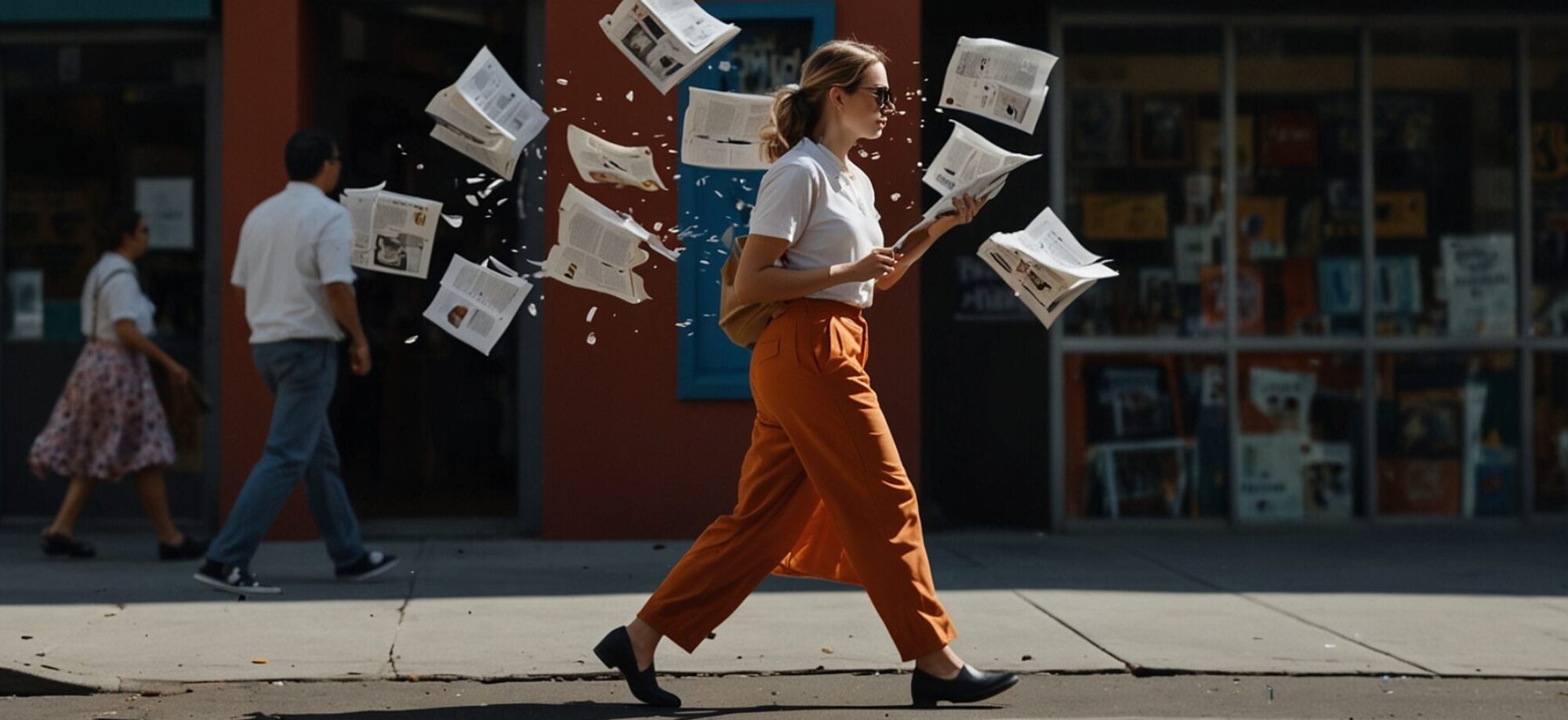
When Memories Decided to Go for a Walk
One early morning, when no one had yet fully opened their windows and the first people were beginning to walk through the streets of Pueblo Quieto (1), something happened that no one could explain.
A memory walked out of a house.
It was not an extraordinary memory.
It carried no date.
It had no name.
It did not know exactly whose memory it had been.
It was simply the memory of an old morning.
It had belonged to someone who had once walked those streets when they were still very different from what they are today.
The memory walked out slowly.
It crossed a doorway.
It stepped down from a sidewalk.
It stopped at a corner.
And then it continued walking.
It did not walk the way human beings walk.
It had no legs.
And yet it moved forward.
Perhaps because memories have a secret way of walking:
they go from one person to another.
The memory reached Morelos Street.
There it found another one.
It was the memory of a man walking with a sledgehammer over his shoulder.
The first one asked:
—Did you also come from a house?
—No —the second replied—. I came from a quarry.
—And what are you doing here?
—I am looking for someone who still remembers me.
The first memory remained thoughtful.
—Then we are companions.
—Why?
—Because I am also looking for someone.
—Who?
—Someone who can think of me again.
The two continued walking.
And that morning Pueblo Quieto began to fill with memories.
They did not all appear at the same time.
Some appeared beside doorways.
Others descended from windows.
Some remained hidden behind family photographs.
Others slept inside drawers.
Some were contained in small objects.
A cup.
A tool.
A photograph.
A stone.
An old toy.
A recipe.
A word.
A name.
And others, the oldest ones, were beneath the sidewalks.
1. THE MEMORY OF THE STONE
The first conversation took place between a stone and a memory.
The stone was resting beside a wall.
The memory approached.
—I know you.
The stone did not answer.
—Yes —the memory insisted—. I know you.
Then the stone asked:
—From where?
—From very far away.
—Stones do not travel very far.
The memory smiled.
—You did.
The stone remained silent.
The memory continued:
—First you were a mountain.
Then volcanic rock.
Then a quarry.
Then a fragment.
Then a wall.
Then a sidewalk.
And now you are simply a stone that someone can touch.
The stone seemed to tremble.
—Does that mean I traveled?
—It means you transformed.
The stone remained still.
The memory added:
—Don’t you remember?
—I remember too many things.
—Then tell me one.
The stone closed its eyes.
Although stones have no eyes, that morning Pueblo Quieto had decided to allow them to have them.
And the stone began to remember.
It remembered fire.
It remembered the birth of the volcanic landscape.
It remembered the wind.
It remembered the rain.
It remembered the cacti.
It remembered the agaves.
It remembered the rabbits.
It remembered the first men.
It remembered the sledgehammers.
It remembered the drills.
It remembered the dust.
It remembered the trucks.
It remembered Mariana.
It remembered the houses.
It remembered the streets.
It remembered the children.
And finally it said:
—Now I understand.
—What do you understand?
—I was not destroyed.
The memory waited.
—I was distributed.
The sentence traveled through the entire street.
It was a sentence that had already been born in the old rock of Pueblo Quieto: the mountain had not completely disappeared; its stones continued living in walls, courtyards, paths, and homes.
The memory smiled.
—Then you walk too.
—Me?
—Yes.
—But I have never moved.
—You do not need to move in order to walk.
The stone reflected on that statement.
Perhaps that was precisely what it had learned from the wind.
The wind could travel across the world.
The stone could remain in the same place.
And yet both could walk.
One carrying stories.
The other preserving them.
2. THE MEMORY AND THE THOUGHT
Farther along, the memory encountered a thought.
—Where are you going? —the memory asked.
—I don’t know.
—Then why are you walking?
—Because I am looking for a question.
The memory was surprised.
—A question?
—Yes.
—Wouldn’t it be more logical to look for an answer?
The thought smiled.
—Not in Pueblo Quieto.
—Why?
—Because here questions have memories.
The memory understood immediately.
It had known many questions.
Mariana’s question:
Do stones hurt?
Morelos’s question:
What is a homeland?
The wind’s question:
Don’t you get tired of always remaining in the same place?
And the question that perhaps stood behind all the others:
What was here before us?
In Memories of Pueblo Quieto (2), the streets begin precisely when they discover that they know many things about the inhabitants, but know nothing about themselves. Then they ask what was there before the houses, the sidewalks, and the lampposts.
The thought stopped.
—That is my question.
—Which one?
—What was here before us?
The memory answered:
—A mountain.
—And before that?
—Fire.
—And before that?
—Time.
—And afterward?
The memory pointed toward the streets.
—Us.
3. THE MEMORIES OF THOSE WHO CAME
By midmorning, memories from other places began to appear.
One came from Guanajuato.
Another from a town in the State of Mexico.
Another carried the smell of a kitchen.
Another preserved the sound of a song.
Another remembered a rainstorm.
Another, a cornfield.
Another, a dirt road.
Another, a house that no longer existed.
They gathered around a stone.
—What are you doing here? —the stone asked.
One of them answered:
—We came with our owners.
—Who were they?
—The men and women who came here to work.
Then the stone understood.
Those memories had arrived with the quarry workers.
Not all of them had been born there.
Many had left their towns behind.
But they had not left their memories behind.
They had brought them with them.
They carried them in the way they spoke.
In their songs.
In the recipes.
In the words they used to name plants, rains, and paths.
Mariana’s mother had explained it with a simple phrase:
—Yes. But they are also planting another one.
And that phrase contained an enormous idea.
Pueblo Quieto had not been built only with volcanic stone.
It had been built with migrant memories.
The stone had come from the depths of the earth.
The memories had come from other towns.
And both began to form the same territory.
One of the memories asked:
—Then does Pueblo Quieto belong to those who were born here?
Another answered:
—Also to those who came here.
Another added:
—And to those who left.
And a fourth memory said:
—And to those who have not yet been born.
Everyone fell silent.
Because they had just discovered something extraordinary:
a neighborhood is not made up only of those who inhabit it today.
It is also made up of those who inhabited it yesterday and those who, in some way, left something of themselves behind for those who will come tomorrow.
4. LIBERTAD STREET AND THE MEMORY OF ITS NAME
That afternoon, a memory encountered Libertad.
—Do you still call yourself that?
The street remained silent.
—They call me Moctezuma now.
—But I remember you as Libertad.
—Many people remember me that way.
—Does it bother you that your name has changed?
Libertad took a long time to answer.
—No.
—Then have you forgotten who you were?
—Neither.
—How can you be Moctezuma and still be Libertad?
The street answered:
—Because names can change.
The memory smiled.
—That is what the stones said.
—What did they say?
—That written names can be erased.
Libertad looked toward the long road that crossed Pueblo Quieto.
—And lived names?
—Those remain.
The street breathed.
—Then I am still Libertad.
—Yes.
—Even if the map says something else.
—Yes.
—Even if someone who has just arrived does not know it.
—Yes.
—Then perhaps maps have memories too.
The memory answered:
—Not all of them.
—Why?
—Because some only record where things are.
—And the good ones?
—The good ones also record what things mean.
Libertad remained silent.
Then she watched a woman walk by.
Then a child.
Then an old man.
And she said:
—Then my true address is not on a map.
—Where is it?
—In the footsteps of those who still remember me.
5. WALKING IS REMEMBERING WITH YOUR FEET
The following day, a walker appeared.
He was an ordinary man.
He did not know about the conversations of the streets.
He did not know that beneath the pavement there was an ancient volcanic landscape.
He did not know that many stones had traveled until they became walls.
He did not know Mariana’s story.
He had not read any of the books.
He was simply walking.
But as he walked, something happened.
His foot touched a stone.
He stopped.
He looked down.
He did not know why.
The stone did not know why he had stopped either.
Then a thought appeared.
—I wonder what lies beneath this street.
The walker continued.
Then another thought appeared:
—Who walked here before me?
Farther along:
—What was this place like a hundred years ago?
And then:
—What stories might have remained here?
The man stopped again.
He had not read anything yet.
And yet he was already reading.
Because walking can also be a form of reading.
Reading a street.
Reading a corner.
Reading a wall.
Reading a shadow.
Reading a stone.
Reading a doorway.
Reading a house.
Reading the way a person crosses a street.
Reading the places where the pavement breaks.
Reading what has been repaired.
Reading what remains.
Reading what disappeared.
And then the walker understood something the streets of Pueblo Quieto already knew:
a city can be read without opening a book.
6. THE THOUGHT THAT LEARNED TO WALK
The thought that was searching for a question decided to accompany the walker.
For several minutes it said nothing.
Then it asked:
—What are you doing?
—Walking.
—Where to?
The man looked ahead.
—I don’t know.
The thought smiled.
—Then you are doing something important.
—What?
—You are allowing the path to teach you.
The man continued walking.
The thought added:
—When you walk without knowing exactly what you are looking for, you begin to find things you did not know you were looking for.
The man looked at an old house.
Then a window.
Then a crack.
Then a small fragment of rock.
He picked it up.
He looked at it.
He put it back.
But he was no longer the same man.
He had begun to look.
And looking attentively is the first step of reading.
7. READING IS MAKING THOSE WHO ARE NO LONGER HERE WALK AGAIN
That night the walker entered a library.
He opened a book.
And something even more extraordinary happened.
The people who were no longer there began to walk.
Mariana appeared.
Mariana’s father appeared.
The quarry workers appeared.
The children appeared.
The men who laid out the streets appeared.
The streets themselves appeared.
The old rock appeared.
The wind appeared.
And even Time appeared.
The reader looked up.
—How did you get here?
Mariana answered:
—You brought us.
—Me?
—Yes.
—But I only opened a book.
—Exactly.
The reader understood then that reading is not merely receiving words.
Reading is opening a path.
Every page is a street.
Every chapter is a neighborhood.
Every character is an inhabitant.
Every memory is a house.
Every thought is a door.
And every reader is a walker.
When someone reads, they make those who became still within the pages walk again.
That is why a book can preserve a mountain.
It can preserve a street.
It can preserve a voice.
It can preserve a childhood.
It can even preserve something that no longer exists.
The young woman who had attended Mariana’s gathering had understood something similar: there came a moment when she stopped writing in order to listen, because taking notes might have caused her to lose the emotion of the memory.
And that experience leads us toward another way of walking.
Writing.
8. WRITING IS LEAVING A PATH
A word appeared on a sheet of paper.
Then another.
Then another.
The words began to form a sentence.
The sentence formed a paragraph.
The paragraph formed a page.
And the page opened a path.
Mariana watched from a distance.
—What is he doing?
The old rock answered:
—He is writing.
—Why?
—So that someone may walk tomorrow where today there is only a memory.
Mariana understood.
That was writing.
Not merely telling what had happened.
It was building a path so that someone else could reach what had happened.
The writer walked toward the past.
The reader would later walk toward the writer.
And between them there would remain a trail made of words.
That is why writing is also walking.
The writer does not remain completely still before a sheet of paper.
Even when his body is sitting, his memory walks.
It goes toward a childhood.
It returns.
It travels to a street.
It comes back.
It climbs a mountain.
It descends.
It enters a house.
It leaves.
It hears a voice.
It follows it.
It finds a stone.
It touches it.
And then it returns to the page.
Every word he places is a footprint.
Every paragraph is a stretch of the path.
Every page is a street.
9. DRAWING IS MAKING MEMORY VISIBLE
But that night a fourth walker appeared.
He carried no book.
He carried no pen.
He carried a pencil.
He sat down in front of a sheet of paper.
And he began to draw.
First a stone.
Then another.
Then a mountain.
But the mountain no longer existed.
So he drew the memory of the mountain.
The pencil continued moving.
It drew a quarry.
A worker.
A sledgehammer.
A path.
A cactus.
An agave.
A house.
A street.
A child.
An elderly woman.
And finally it drew Mariana holding a stone.
The drawing was finished.
The stone looked at it.
—Do you recognize me?
The drawing answered:
—Not exactly.
—Then why did you draw me?
—Because I did not want to draw only your shape.
—What did you want to draw?
—What you mean.
The stone remained silent.
That was difficult.
Because drawing Pueblo Quieto did not simply mean representing its streets.
One also had to draw what cannot be seen.
A worker’s fear.
A family’s hope.
The nostalgia of someone who had left their hometown.
Fatigue.
Dust.
The children’s joy.
The smell of a kitchen.
The memory of a mountain.
The absence of those who left.
The presence of those who remained.
And then the artist understood:
drawing is another way of listening.
The pencil listens to the eyes.
The paper listens to the pencil.
And the reader listens to the drawing afterward.
10. FOUR WALKERS
At dawn the four of them met.
The Walker.
The Reader.
The Writer.
The Artist.
All four were standing in front of Morelos Street.
The Walker asked:
—What are we doing here?
The Reader answered:
—Reading.
The Writer said:
—Writing.
The Artist added:
—Drawing.
The Walker smiled.
—And me?
The other three looked at him.
—You make everything else possible.
—How?
The Reader answered:
—Without walking, you might never find the story.
The Writer added:
—Without walking, you might never have anything to tell.
The Artist said:
—Without walking, you might never discover what you need to draw.
The Walker remained silent.
Then he asked:
—And can you walk with me?
The Reader said:
—Yes.
The Writer:
—Always.
The Artist:
—As long as there is a sheet of paper.
And so they began to walk.
11. THE NEIGHBORHOOD AS A BOOK
They walked along Morelos.
Then they reached Juárez.
Then Hidalgo.
After that, they walked along the old Libertad.
The Walker asked questions.
The Reader observed.
The Writer took notes.
The Artist drew.
And the streets spoke.
Morelos said:
—There were footsteps here.
Juárez added:
—There were decisions here.
Hidalgo said:
—There were beginnings here.
Libertad finally spoke:
—And there were people here who walked in search of a different life.
The Walker asked:
—Where are they now?
The streets fell silent.
Then the old rock appeared.
—They are here.
—Where?
—In you.
The Walker looked at his feet.
The Reader looked at his book.
The Writer looked at his page.
The Artist looked at his drawing.
They understood.
People do not remain only in photographs.
They remain in the places they transformed.
In the words they spoke.
In the recipes they taught.
In the paths they traveled.
In the stories they passed on.
In the stones they touched.
And in the people who still remember them.
12. WHEN MEMORY MEETS THOUGHT
At the end of the street they found the memory again.
It was sitting beside a thought.
They seemed to be arguing.
—I am more important —said the memory.
—No —the thought replied—. I am more important.
—Without me, you would not exist.
—Without me, you would not know what you mean.
The memory reflected.
—Then we need each other.
The thought answered:
—It seems so.
—What shall we do, then?
—Walk together.
And they began to walk.
The memory went ahead.
The thought followed behind.
Then they changed places.
Sometimes the memory led.
Sometimes the thought did.
And little by little they discovered that they could not be separated.
Because a memory without thought can become nostalgia.
And thought without memory can become abstraction.
But when the two walk together, something different appears:
understanding.
13. MARIANA GOES FOR ANOTHER WALK
As evening fell, Mariana opened the door of her house.
She was already an old woman.
She walked a few steps.
She touched the wall.
Then the sidewalk.
Finally, she found a stone.
She took it in her hands.
The reader walking behind her could hear her say:
—You were up there.
It was the same scene that had opened Memorias de Pueblo Quieto: Mariana, now elderly, walking along an avenue in southern Mexico City, touching a stone and recognizing in it a fragment of her past.
But this time something different happened.
The stone answered her.
—And you were with me.
Mariana smiled.
—Do you remember me?
—We stones do not forget.
Mariana gently squeezed the stone.
—Then we are still walking.
—Yes.
—Where to?
The stone answered:
—Toward those who do not know us yet.
Mariana understood.
That was the true journey of memory.
Not returning to the past.
Walking toward the future while carrying the past with us.
14. THE DIASPORA OF THE STONES CONTINUES
For a long time we thought that when a stone leaves a mountain, it moves away from it.
Perhaps the opposite is true.
Perhaps the stone continues carrying the mountain within it.
A stone placed in a wall can still be a mountain.
A stone turned into a sidewalk can still be volcanic rock.
A stone that someone keeps in a box can still be territory.
A stone given by an elderly woman to a child can become an inheritance.
And a stone transformed into a word can become literature.
That is why the diaspora of the stones did not end.
It continues.
Every time a wall is touched.
Every time a street is walked.
Every time someone asks what was here before.
Every time someone remembers.
Every time someone writes.
Every time someone draws.
Every time someone reads.
The stone walks again.
15. MEMORIES HAVE LEGS TOO
Perhaps that is why, that morning, all the memories of Pueblo Quieto decided to come out.
The memory of the first drill.
The memory of the dust.
The memory of the cooking fire.
The memory of the workers.
The memory of the children.
The memory of the first trucks.
The memory of the dirt roads.
The memory of the first houses.
The memory of the names.
The memory of Libertad Street.
The memory of those who arrived.
The memory of those who left.
The memory of Pedernal.
The memory of Mariana.
And they all began to walk.
They were not walking backward.
They were walking forward.
Because a memory that only looks backward can become stuck.
But a memory that finds someone willing to listen to it can walk again.
And then a thought appeared:
What will Pueblo Quieto be like a hundred years from now?
The memory answered:
—That depends on you.
—On us?
—Yes.
—Why?
—Because the future of a place also depends on what it chooses to remember.
16. MEMORY NEEDS WALKERS
The old rock called for the wind.
The wind came.
Then it called the streets.
Morelos, Juárez, Hidalgo, and Libertad came.
Then it called Mariana.
Then the memories.
Then the thoughts.
And finally it called the Walker, the Reader, the Writer, and the Artist.
They all gathered together.
The old rock spoke:
—I have kept this story for a very long time.
No one answered.
—Now I need you to carry it.
The Walker asked:
—How?
—By walking.
The Reader:
—How?
—By reading.
The Writer:
—How?
—By writing.
The Artist:
—How?
—By drawing.
The wind began to move.
The leaves of the trees trembled.
The streets seemed to awaken.
And the old rock concluded:
—Because a memory that remains locked away eventually becomes silence.
The Walker understood.
The Reader understood.
The Writer understood.
The Artist understood.
Mariana understood too.
17. AND THEN PUEBLO QUIETO WALKED AGAIN
That night something happened that no one could record.
It did not appear in the newspapers.
It was not written down in any document.
No one took a photograph.
But the streets knew.
Pueblo Quieto walked.
Its houses did not move.
Its sidewalks did not move.
Its walls did not shift.
Its memory walked.
Its history walked.
Its absent inhabitants walked.
Its workers walked.
Its children walked.
Its questions walked.
Its thoughts walked.
Its stones walked.
And its words walked.
The ancient volcanic landscape walked within the streets.
The streets walked within the books.
The books walked within the readers.
The readers walked within their own thoughts.
The thoughts returned to the territory.
And the territory became memory once again.
It was a circular movement.
Like breathing.
Like the wind.
Like walking.
18. EPILOGUE
A STREET CAN BE READ
If you ever walk through Pueblo Quieto, perhaps you will find nothing extraordinary.
You will find streets.
Houses.
Sidewalks.
Walls.
Doors.
Windows.
Trees.
People.
Perhaps a stone.
And, apparently, that will be all.
But stop.
Walk more slowly.
Look.
Read.
Listen.
Draw.
Write.
Ask yourself:
What was here before me?
Then ask:
Who walked through this same place before I did?
And then:
What thoughts did they leave here?
Perhaps you will discover that a street is never just a street.
It is a page.
A stone is never just a stone.
It is a memory.
A house is never just a house.
It is an accumulation of lives.
A name is never just a name.
It is a promise to remember.
And walking is never simply moving from one place to another.
It is coming into contact with time.
Because when we walk, our feet read.
When we read, our thoughts walk.
When we write, we leave paths behind.
When we draw, we make visible what memory does not want to lose.
And when we remember together…
the place comes alive again.
Perhaps that is why the old rock was right.
It was not destroyed.
It was distributed.
And perhaps Pueblo Quieto did not disappear either.
It was distributed.
It is in its stones.
In its streets.
In its houses.
In its inhabitants.
In its memories.
In its books.
In its drawings.
In its thoughts.
And in every person who still has enough curiosity to walk down a street and ask:
—What do you remember?
Then the street will answer.
Perhaps slowly.
Perhaps with a murmur.
Perhaps through a stone.
Perhaps through a memory.
Perhaps inside a book.
But it will answer.
Because streets that have learned to listen never become completely silent again.
And Pueblo Quieto…
is still walking.
WALK. READ. WRITE. DRAW.
Four actions.
Four paths.
Four ways of entering the same territory.
Walk to discover it.
Read to listen to what others discovered.
Write so that what we discover does not disappear.
Draw so that what words cannot reach can appear once again before our eyes.
And perhaps there is a fifth action that brings them all together:
remember.
Because remembering means allowing the past to keep walking within the present.
And as long as someone walks through Pueblo Quieto wondering what existed before their footsteps, as long as someone reads its stories, as long as someone writes new ones, and as long as someone draws what still remains hidden behind the stones…
Pueblo Quieto will continue to be a town in motion.
Even though its name is Quiet.

(1) Loya Lopategui, Carlos, Pueblo Quieto, EMULISA, México, 2015

(2) Loya Lopategui, Carlos, Memories of Pueblo Quieto. The Diaspora of the Stones, EMULISA, México, 2026