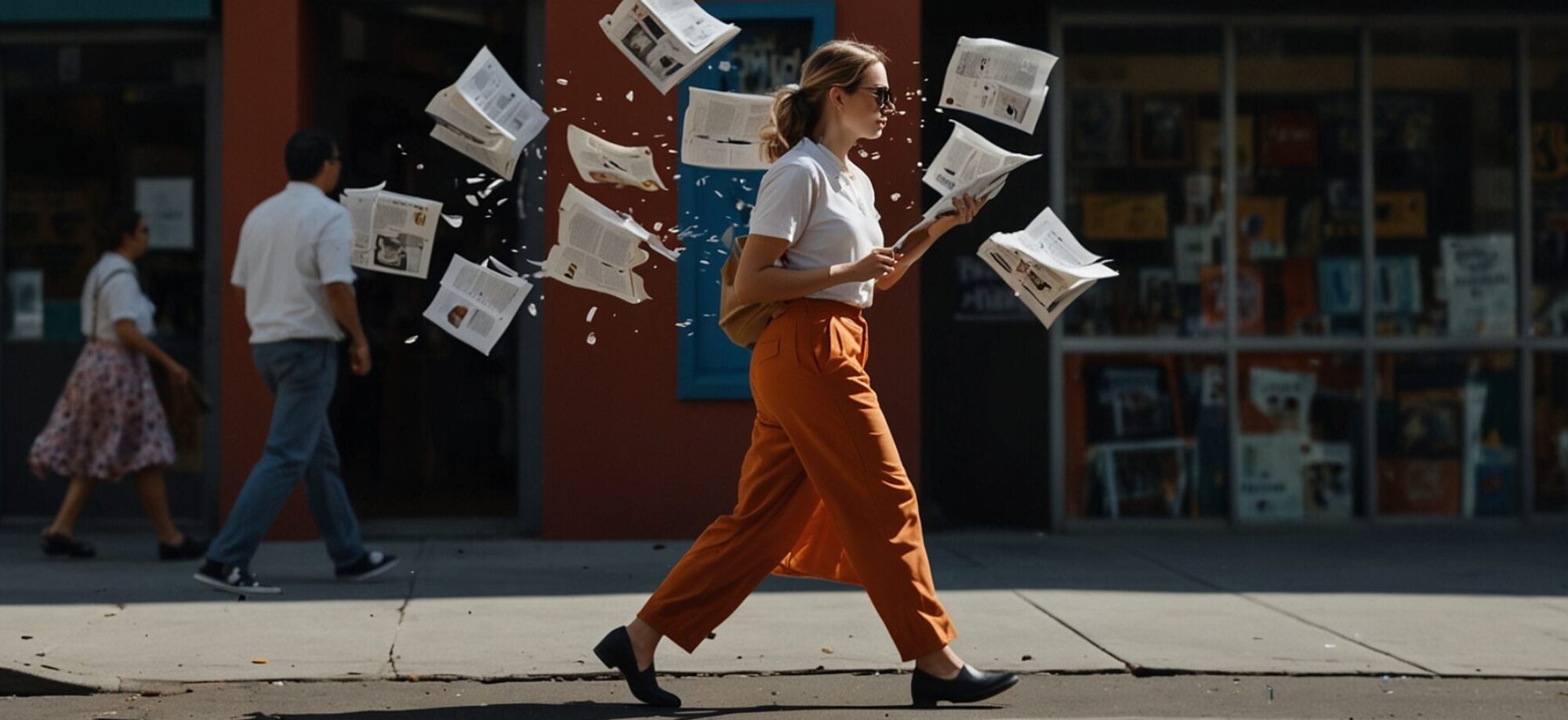
For centuries, we have thought that walking and reading belong to different worlds.
Walking seems to be an activity of the body.
Reading, an activity of the mind.
Yet my lifelong experience as both a reader and a writer has led me to a different conclusion: both are ways of traveling through a landscape.
Those who walk discover places.
Those who read discover ideas.
Those who walk gradually transform the way they see the world.
Those who read gradually transform the way they understand it.
Perhaps that is why, for many years, I have felt that books can also be walked through.
Not simply because we can read while strolling through a park, along a beach, or across a mountain trail, but because every meaningful act of reading is itself an inner journey. No important book leaves us exactly where we were when we opened its first page. By the time we close it, something within us has changed: a new question, an unexpected insight, a relationship between ideas that did not exist before, a case of Achronism (Post # 138 THE PROPER MANAGEMENT OF SLACK TIME IN THE DECISION TO WALK), or a Synchronicity (Post 234 WALKING WITHIN BOOKS. PART II: SYNCHRONICITY).
To walk inside a book is to welcome that transformation.
It is to move through its pages as one crosses an unfamiliar landscape, allowing the literary world to enter into dialogue with one’s own experience.
Reading then ceases to be merely an act of gathering information.
It becomes an experience of discovery.
It is precisely this understanding of reading that inspired the creation of the Circle of Readers in Motion Without Borders (CIM).
Since publishing the invitation to our first gathering, several people have expressed genuine interest in the initiative. However, we have not yet reached the number of participants needed to create the dynamic exchange of ideas that we envision.
Far from considering this a setback, I see it as an opportunity.
Cultural communities are not created overnight.
They grow gradually through shared ideas, mutual trust, and the discovery of a common purpose.
For that reason, we have decided to postpone the first CIM meeting until Saturday, September 26.
These additional two months will allow us to continue strengthening the project, deepen its philosophical foundations, welcome new participants, and prepare a reading experience that truly offers something different.
Our goal is not simply to gather people who have read the same book.
Our goal is to create a space where books continue to live through conversation.
With that purpose in mind, I am pleased to introduce today the Manifesto for a New Culture of Reading, the founding document of the Circle of Readers in Motion Without Borders.
This manifesto begins with a simple yet deeply transformative conviction: reading does not end when we finish a book. It continues when its ideas begin to converse with other people, other experiences, and new questions.
For a long time, we regarded books as completed works.
Today, we begin to explore another possibility.
To understand them as living organisms capable of continuing to grow within the minds of those who read them, discuss them, question them, and extend them through new conversations.
The manifesto does not seek to replace the quiet, intimate experience of reading.
Nor does it diminish the unique encounter between a reader and a book.
On the contrary.
It seeks to expand it.
It invites us to discover a second dimension of reading: the one that emerges when different minds come together to think collectively.
For perhaps the true destiny of a great book is not simply to be read.
Perhaps it is also to be discussed.
Over many years I have explored this idea through a variety of literary forms.
Sometimes through novels.
Sometimes through philosophical essays.
At other times through symbolism, experimental fiction, and literary exploration.
The six books presented at the end of this post are part of that long journey.
Although they were written at different moments and belong to different genres, they all share the same underlying question: how does the reader participate in the creation of meaning, and how can reading itself become an act of creation?
Today I look back at those works from a new perspective.
Perhaps each of them was quietly preparing the way for this moment.
The birth of the Circle of Readers in Motion Without Borders.
And the possibility of continuing to walk inside books—not alone, but together with other voices, other perspectives, and other ways of thinking.
For there are books that we read.
There are books that we study.
There are books that we remember.
But there are others—far rarer—that continue speaking with us long after they have been closed.
The purpose of the CIM is to find those books.
And to continue those conversations.
The following pages present the Manifesto for a New Culture of Reading, followed by a brief selection of six books that, from different literary perspectives, explore the reader’s role as an active participant in a living, reflective, and transformative reading experience.
MANIFESTO FOR A NEW CULTURE OF READING
Founding Document of the Circle of Readers in Motion Beyond Borders (CIM)
For centuries, we have understood reading as an essentially solitary act.
One reader.
One book.
One mind moving silently through the pages of a work.
From that tradition emerged libraries, universities, schools, systems of thought, and much of the culture we have inherited.
Yet the twenty-first century invites us to ask a different question:
What new possibilities emerge when reading ceases to be only an encounter between a reader and a book, and also becomes a conversation among minds?
That question marks the beginning of the Circle of Readers in Motion Beyond Borders (CIM).
We were not created to replace traditional reading.
We do not seek to diminish the quiet pleasure of reading alone.
Nor do we question the value of silence.
We seek to expand the possibilities of the reading experience.
We believe that every book possesses more than one life.
Its first life begins when it is written.
Its second begins when it is read.
But there is a third life—far less explored—which begins when the ideas contained in a book enter into dialogue with other people, other experiences, other questions, and other ways of understanding the world.
It is within that living space that conversation is born.
And it is there that a book begins to reveal possibilities that even its author could never have foreseen.
For that reason, we affirm that the central figure of our time is not only the book.
Nor only the author.
Nor even only the reader.
The true protagonist is conversation.
For every genuine conversation brings into existence something that did not exist before.
A new understanding.
A new relationship between ideas.
A new question.
A new possibility.
Whenever several people read the same work, each discovers something different.
Some notice the events.
Others the emotions.
Others the ideas.
Others the silences.
None of these readings is complete on its own.
Yet when they enter into dialogue, the book becomes broader.
Deeper.
More alive.
Conversation does not replace reading.
It extends it.
Enriches it.
Expands it.
For this reason, we believe that reading can also become an act of creation.
Not because readers alter the printed words.
But because every reading establishes new relationships between the work itself and the lived experience of the person who encounters it.
Every reader recreates, in part, the book they read.
And when many readers share that recreation, a form of knowledge emerges that none of them could have created entirely alone.
For a long time, we regarded books as closed structures.
Finished objects.
Completed intellectual monuments.
Today, we begin to explore another possibility.
To understand great works as open cultural organisms.
The words remain.
But their meanings continue to evolve.
The pages do not change.
Yet the conversations they generate continue to grow.
That is why certain books seem to become younger with every passing century.
The text does not change.
Readers do.
Questions do.
Conversations do.
And with them, meaning itself evolves.
From this perspective, reading ceases to be merely an act of reception.
It becomes an act of participation.
Every reader becomes part of a conversation far larger than any individual book.
A conversation that began long before us.
And that will continue long after us.
A conversation that crosses generations, cultures, languages, and borders.
The Circle of Readers in Motion Beyond Borders was created to participate consciously in that ongoing dialogue.
We are not a conventional book club.
We are not an academic institution.
We are not a school.
We are a meeting place for those who wish to explore a more participatory, more reflective, and more creative way of reading.
We believe that books do more than preserve knowledge.
They also generate relationships: of ideas, of questions, of thoughts, of answers, of experiences, of content, …
And very often, it is those relationships that transform the way we understand reality.
For that reason, we affirm the following principles:
We believe that:
- No important book truly ends with its final page.
- Every great work longs to be discussed.
- Reading is also an act of creating meaning.
- Questions are as valuable as answers.
- Conversation is a powerful instrument of knowledge.
- Thinking together allows us to discover relationships invisible to isolated thought.
- Every profound reading transforms the reader.
- Every genuine conversation transforms those who take part in it.
- Knowledge evolves as relationships among ideas evolve.
- Culture flourishes when people learn to think together through books.
Our aspiration is both simple and ambitious.
We seek to contribute to a new culture of reading.
A culture in which books continue to occupy a central place.
But one in which conversation also recovers the essential role it has always played in the construction of human knowledge.
Conversation lived in the public squares of ancient Greece.
In philosophical schools.
In libraries.
In literary salons.
In cafés.
In universities.
In workshops.
In the margins of books.
Today, it can once again become one of the great cultural forces of our communities.
We are not simply looking for readers.
We are looking for people willing to think together.
To listen.
To ask.
To disagree.
To discover.
To build knowledge collectively.
For perhaps the future of reading will not consist merely in understanding books more deeply.
Perhaps it will also consist in learning to converse more profoundly because of them.
And perhaps there lies one of the greatest cultural opportunities of our time.
There are books we read.
There are books we study.
There are books we remember.
But there are others—far rarer—that continue speaking with us long after they have been closed.
The Circle of Readers in Motion Beyond Borders was created to find those books.
And to continue those conversations.

Loya Lopategui, Carlos, Reader Peripathenias, EMULISA, Mexico, 2025. Available on Amazon, Kindle Edition: https://www.amazon.com/dp/B0CSS9RM2J
Loya Lopategui, Carlos, The Circle of Silent Storytellers, EMULISA, Mexico, 2025. Available on Amazon, Kindle Edition: https://www.amazon.com/dp/B0DMKPX5SK
Loya Lopategui, Carlos, Time. Circus Engrams, EMULISA, Mexico, 2025. Available on Amazon, Kindle Edition: https://www.amazon.com/dp/B0FX5HR6L9
Loya Lopategui, Carlos, The Walker and his Shadow. Myth of a Nomadic Tower, EMULISA, Mexico, 2025. Available on Amazon, Kindle Edition: https://www.amazon.com/dp/B0GQ2DS9RY
Loya Lopategui, Carlos, The Six Portals of Being, EMULISA, Mexico, 2025. Available on Amazon, Kindle Edition: https://www.amazon.com/dp/B0GGTZ1MY9
Loya Lopategui, Carlos, Get me out of here, EMULISA, Mexico, 2025. Available on Amazon, Kindle Edition: https://www.amazon.com/dp/B0H4C2LCPJ
See you next Saturday, September 26, 2026.