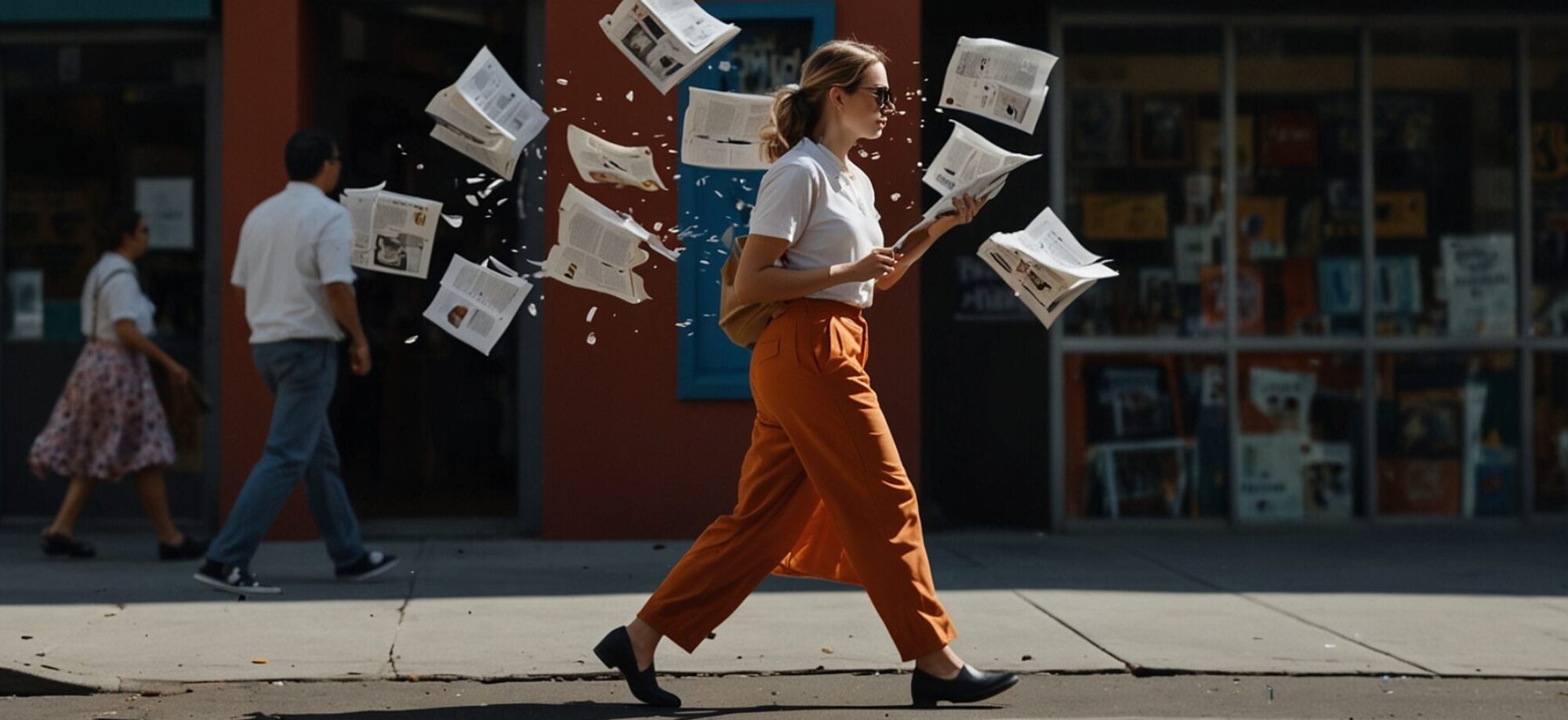
A Moving Manifesto for the New Walkers of the 31st Century
“Memory is not housed in walls, but in the skin that has brushed against them a thousand times when passing by.” Fragment rescued from the walls of the Unfading House (1), year 3098.
I. WALKING AS AN ARCHITECTURAL ACT
Walking is, in itself, a form of architecture. But not the kind built with concrete or algorithms; rather, it’s a dermal architecture: an architecture that is built and eroded on the skin. Every step is a contact with the ground, with the wind, with the textures of the world, with what once was.
We don’t need more roofs; we need journeys. We live in an era—that of Toxic Realism—where structures no longer protect us; they sicken us, isolate us, watch us, deceive us with promises of security while stripping us of our souls. In this domestic dystopia, walking becomes a form of dissent, a living design, unstable but genuinely human.

II. WALKING ON RUINS
The Unfading House, whose history extends to the year 3100, has not physically collapsed… but it has emotionally. Its fallen walls still stand in some parts, but they are symbolic ruins, fragments of a civilization that forgot itself.
Walking on these ruins—not just on stones but on eroded experiences—transforms into a way of reading the past with our feet, as if each step were a syllable of a secret language that only the body can interpret. Walking is, then, a bodily reading of memory, of past emotions (2).
These ruins are not just the ruins of a house, but of a model of life, of a way of thinking, of an emotion, of a false idea of progress.
III. THE SKIN AS A MAP
Our feet, our soles, our legs… have been forgotten in the equation of modern existence. We have been immobilized by screens, by sedentary jobs, by the false promise of digital hyperconnectivity. But what is disconnected is not the WiFi: it is the body from the world, it is the body from its own silenced emotions.
Walking reactivates the skin as a map. We don’t need compasses if we recover the dermal sense of space. When we walk, we don’t seek a destination: we seek to remember what we were to feel past emotions, reconstruct what we are, reimagine what we could be.
IV. TO REMEMBER IS TO WALK
The act of walking not only stimulates the body: it stimulates emotional, tactile, unconscious memory. Each journey activates dormant memories, forgotten thoughts, sensations that were encapsulated by the toxic architecture of confinement.
Walk in solitude or in company. Walk aimlessly. Walk on cities that no longer exist. Walk as a method of healing. Walk as a way to see each other again, and to see ourselves again within ourselves.
V. WALKING AS INSURRECTION IN ARCHETH
In the ARCHETH: Architectural Echo-Transfer Hub program (3), walking is not a recreational activity. It is an essential axis for reconfiguring time, identity, and knowledge. Walking is an ancient technology. In a hyperdigital world, walking is not primitive; it is revolutionary.
ARCHETH also functions as a platform for receiving Architectural Echos and for transmitting all kinds of emotional memories, both positive and negative.
ARCHETH proposes a mutant, organic urbanism, where routes are more important than buildings. Walkable cities are not a luxury: they are a spiritual urgency. In ARCHETH, each walk generates an “emotional cartographic modification (correction)” that is recorded not in satellites, but in the fabrics of collective consciousness.
VI. REASONS TO WALK: A CALL TO HUMANITY
Walk to breathe with your whole body. 🦶 Walk to exit the algorithm. 🦶 Walk to touch the world with your skin. 🦶 Walk to remember without the need for screens. 🦶 Walk so you don’t become a ruin. 🦶 Walk to emotionally assimilate Toxic Realism. 🦶 Walk because the future is built step by step. 🦶 Walk because there is no house anymore, but there is a path.
VII. CONCLUSION: THE FIRST STEP
The Unfading House still inhabits our minds. Its corridors are within us. But it’s no longer enough to inhabit it. We must leave it behind. We must walk on its ruins to understand its message and free ourselves.
Because in the 31st century, and just like now, there is only one way to save the human soul: to walk again.
#ToxicRealism #ArchitectureOfMemory #WalkingIsRevolution #TheUnfadingHouse #ARCHETH #WalkThinkFeel #WalkingOnRuins #DermalArchitecture
(1) Loya Lopategui, Carlos, The Unfading House, EMULISA, Mexico, 2025. Available on Amazon, Kindle Edition: https://www.amazon.es/dp/B0FJ6HZKC1
(2) Loya Lopategui, Carlos, Anapopatehia: Reliving the Emotions of the Past, EMULISA, Mexico, 2024. Available on Amazon, Kindle Edition: https://www.amazon.com/dp/B0DPJL579C
(3) Loya Lopategui, Carlos, ARCHETH: Architecture of Memory and Forgetting, EMULISA, Mexico, 2025. Available on Amazon, Kindle Edition: https://www.amazon.es/dp/B0FL1H1DBT