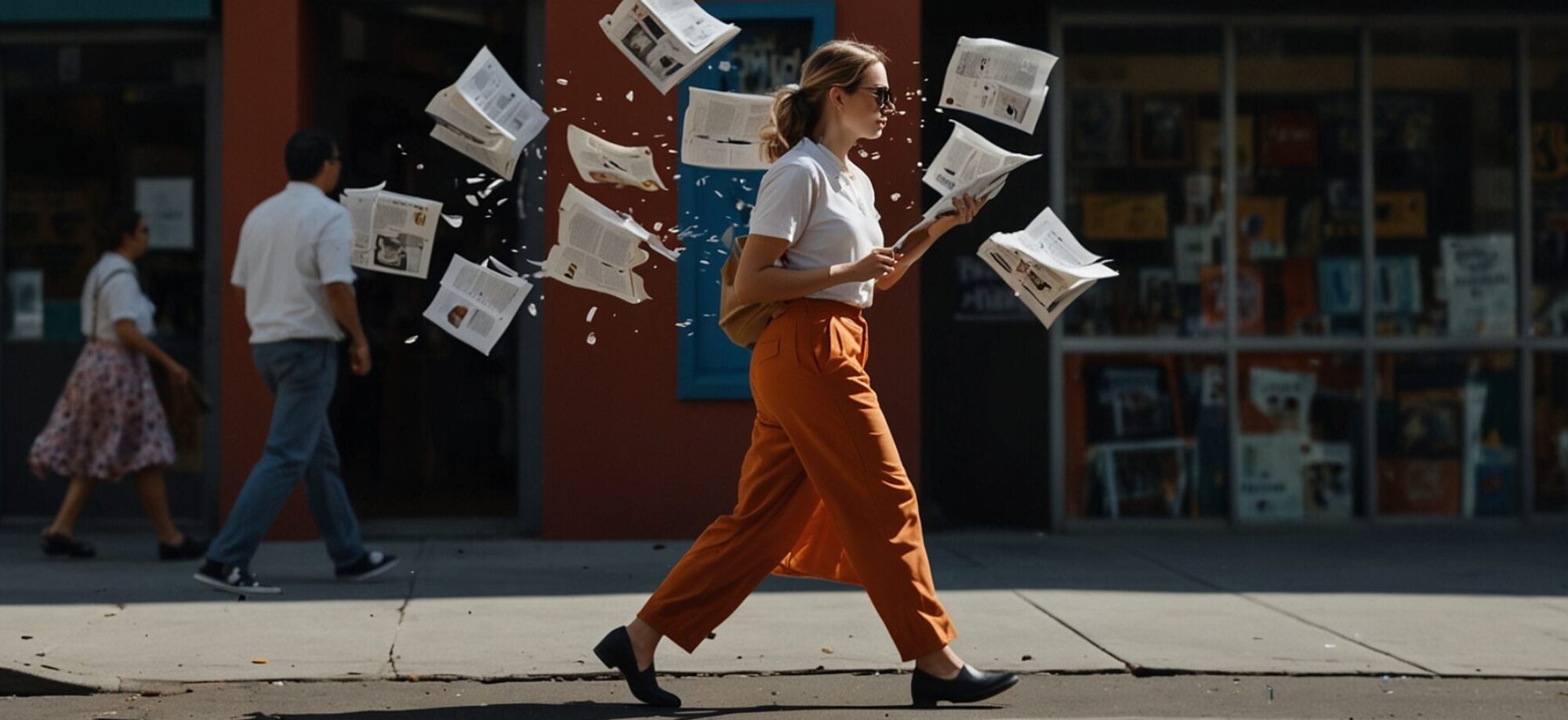
Change of Pace
Starting this July—the beginning of our eighth year walking together—this blog will take another step forward: we will increase the frequency of our publications from two to three posts per month. This change does not respond to whim or a desire to fill time with words, but to a profound need imposed upon us by the context itself: the incessant acceleration of the world, driven by the vertigo of technology, by the increasingly intense rhythms of daily life, and by the multiple faces of what we have called Toxic Realism.
This Toxic Realism—at once a phenomenon and a diagnosis—not only describes an era saturated with stimuli, contradictions, and automatisms, but also urgently points us to new forms of resistance, lucidity, and reconnection. Walking, as we have repeatedly maintained, is not just a physical exercise: it is a practice of slowing down, a way of thinking with the body, an act of silent freedom that opposes, step by step, the overwhelming flow of the immediate.
Therefore, adding one more post per month—always on the 7th—responds to a new rhythm that doesn’t subordinate us to chaos, but rather allows us to consciously accompany it. We need more moments of reflection, more stories on the go, more poetic and symbolic strategies to maintain balance in the face of this global acceleration that, if not addressed, can wipe us off the map of our own interiority.
Increasing the number of posts by 50% isn’t just a number: it’s a sign, a sign that this Blog raises like a torch that won’t give up. It’s a firm gesture on the path, like someone who decides to take a longer break to observe the world through different eyes, or someone who takes a detour to find a forgotten flower. May each monthly post—on the 1st, the 7th, and the 15th—be an act of lucid breathing in the face of vertigo. Walking is also publishing.
START OF THE POST
Walking Separately from Death
Have you ever stopped to think about how absurd it is to keep walking? I’m not talking about that low-intensity activity doctors and wellness gurus tout as a panacea for a long and prosperous life. What a farce! I’m referring to the fundamental, almost instinctive, act of moving one leg after the other. Ever since the first hominid decided to stand upright and stumble with gravity, we’ve been on this incessant pilgrimage. Towards where, exactly?
My recently published book, “Program Your Death and Rebirth” (1), delves into those uncomfortable truths we prefer to sweep under the carpet of consciousness—those that ferment in the basement of our psyche until they reek of “toxic realism.” And, to be honest, is there anything more toxically real than the fact that every step we take is one step closer to the inevitable end?
Yes, I know, people walk for health, for pleasure, to explore, to escape their problems… How naive! We walk because we are designed for perpetual motion that inexorably drags us towards nothingness. It’s the cruelest cosmic joke of all: to be born with legs for a race with no finish line, only an abyss at the end.
Consider, for a moment, those hiking enthusiasts, with their backpacks full of energy bars and their gleaming sneakers. Do they not see the irony? They venture into the wild, seeking “connection” or “inner peace,” while every rock they dodge and every river they cross brings them closer to that final rest, the one where they’ll no longer need marked trails. How hilarious! It’s as if the universe is laughing out loud at our eagerness to prolong the march when our destiny is already sealed.
And let’s not talk about marathon runners. Ah, marathon runners! Those beings who, with an almost frenetic or pathological enthusiasm, inflict physical tortures upon themselves to prove… what? That they can postpone the inevitable with every blister on their foot? It’s the equivalent of building a sandcastle against a high tide; a noble effort, yes, but utterly useless. “Run for your life!” the signs scream. And one wonders, for what, if the final prize is immobility? Perhaps their true goal is to reach the finish line so exhausted that death finds them already half-dead. Now that would be a Pyrrhic victory if there ever was one.
The Great Paradox of the Step
The relationship between walking and death is as intrinsic as a pair of smelly socks to a teenager. Ever since we stood up, we’ve been dancing a macabre tango with destiny. In the melody of our ephemeral existence, every step is a beat, every kilometer, a verse; some prefer a slow, contemplative waltz, others, a rhythmic “paso doble” towards the void. In the end, we all end up dancing the same mournful piece.
Think of the elderly, with their walkers and their hesitant steps. They say they walk to “stay active,” to “delay deterioration.” Nonsense! It’s the last gasp of a machine that refuses to shut down, a pathetic resistance to the call from the beyond. Wouldn’t it be more dignified to simply sit and wait comfortably? But no, human stubbornness compels us to keep moving, even when every movement is a reminder of our fragility, and the imminent risk of a possible fracture that anticipates our fall into that void.
And what about or what to think of people who don’t want to walk? Are they wiser? Those who prefer the sofa, the car, the bed? We could argue that they have understood the ineffectuality of futile exercise. They have decided to shorten the path, to avoid the farce of effort. Perhaps they are the true visionaries, those who have anticipated the message of this book and have “programmed their death” with glorious inactivity. Why sweat if destiny is already written? Although we don’t know if by doing so they risk a high burden of self-blame that shortens their last stretch… to elude the rhythm of tempos.
Where are we limping, then?
First and foremost, a kind warning: The book “Program Your Death and Rebirth” is not a suicide manual, let that be very clear. This reading is an invitation “to die laughing” and thus ensure several more years of existence, but always walking. It’s an invitation to parody and uncomfortable laughter in the face of the inevitable. And the vital act of walking, that seemingly banal act, is one of existence’s greatest parodies. By confronting the multiple conditionings, programs, even new technological applications to lucratively increase longevity, and with it life expectancy, which does not encourage chasing a mirage. We move, we strive, we climb mountains and cross deserts, only to realize that the true destination is absolute immobility.
But what if that very futility is what keeps us going? What if the inherent sarcasm of walking towards the grave is what gives our ephemeral existence an absurd and delightful meaning? Perhaps, just perhaps, the act of walking is the ultimate act of rebellion, a slap in the face of death. “Here I am, damn it!” shouts every step, “Even if you take me, at least you’ll take me in motion!”
So, the next time you find yourself dragging your feet to the kitchen for a third slice of cake, or climbing a mountain to watch the sunrise, remember this: you are participating in the greatest parody of all. You are walking separately from death, but at the same time, hand in hand with it. It’s a tango, a waltz, a macabre dance that unites us all, from Olympic athletes to the wandering souls who haven’t yet found their way back to the ether.
Even souls, those floating around, could benefit from this. If only they could find a pair of borrowed legs, perhaps they would understand the joke. Perhaps they would even be encouraged to take a walk. After all, who says the dead can’t enjoy a good ironic stroll in the afterlife?
Walk seriously, ironically, however you decide; but walk every day.
(1) Loya Lopategui Carlos, Program Your Death and Rebirth, EMULISA, Mexico, 2025. Available on Amazon, Kindle Edition: https://www.amazon.es/dp/B0FGMFRD5P